chemistry 2nd sem study guide module 8 - 10+15\n17) iron is obtained commercially by the reaction of…
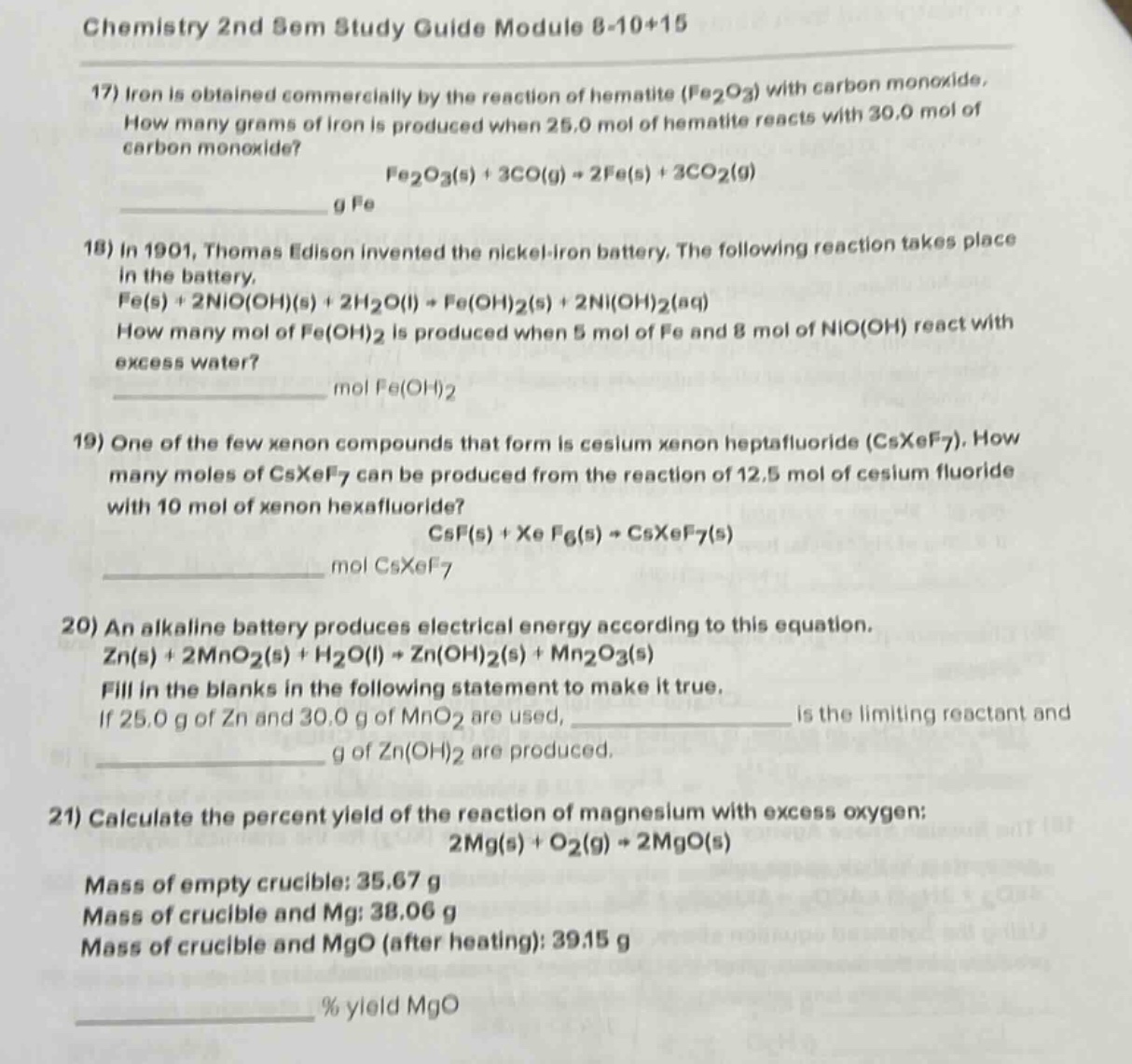
chemistry 2nd sem study guide module 8 - 10+15\n17) iron is obtained commercially by the reaction of hematite (fe₂o₃) with carbon monoxide. how many grams of iron is produced when 25.0 mol of hematite reacts with 30.0 mol of carbon monoxide?\nfe₂o₃(s) + 3co(g) → 2fe(s) + 3co₂(g)\ng fe\n18) in 1901, thomas edison invented the nickel - iron battery. the following reaction takes place in the battery.\nfe(s) + 2nio(oh)(s) + 2h₂o(l) → fe(oh)₂(s) + 2ni(oh)₂(aq)\nhow many mol of fe(oh)₂ is produced when 5 mol of fe and 8 mol of nio(oh) react with excess water?\nmol fe(oh)₂\n19) one of the few xenon compounds that form is cesium xenon heptafluoride (csxef₇). how many moles of csxef₇ can be produced from the reaction of 12.5 mol of cesium fluoride with 10 mol of xenon hexafluoride?\ncsf(s) + xef₆(s) → csxef₇(s)\nmol csxef₇\n20) an alkaline battery produces electrical energy according to this equation.\nzn(s) + 2mno₂(s) + h₂o(l) → zn(oh)₂(s) + mn₂o₃(s)\nfill in the blanks in the following statement to make it true.\nif 25.0 g of zn and 30.0 g of mno₂ are used, ____________ is the limiting reactant and ____________ g of zn(oh)₂ are produced.\n21) calculate the percent yield of the reaction of magnesium with excess oxygen:\n2mg(s) + o₂(g) → 2mgo(s)\nmass of empty crucible: 35.67 g\nmass of crucible and mg: 38.06 g\nmass of crucible and mgo (after heating): 39.15 g\n% yield mgo
Answer
17
Explanation:
Step1: Determine the limiting reactant
The balanced equation is $\ce{Fe2O3(s) + 3CO(g)\rightarrow2Fe(s)+3CO2(g)}$. The mole - ratio of $\ce{Fe2O3}$ to $\ce{CO}$ is $1:3$. Given $n_{\ce{Fe2O3}} = 25.0\ mol$ and $n_{\ce{CO}}=30.0\ mol$. For $25.0\ mol$ of $\ce{Fe2O3}$, the required amount of $\ce{CO}$ is $n_{\ce{CO}_{required}}=25.0\times3 = 75.0\ mol$. Since we have only $30.0\ mol$ of $\ce{CO}$, $\ce{CO}$ is the limiting reactant.
Step2: Calculate the moles of $\ce{Fe}$ produced
From the mole - ratio of $\ce{CO}$ to $\ce{Fe}$ which is $3:2$, if $n_{\ce{CO}} = 30.0\ mol$, then $n_{\ce{Fe}}=\frac{2}{3}\times n_{\ce{CO}}=\frac{2}{3}\times30.0\ mol = 20.0\ mol$.
Step3: Calculate the mass of $\ce{Fe}$ produced
The molar mass of $\ce{Fe}$ is $M_{\ce{Fe}}=55.85\ g/mol$. So the mass of $\ce{Fe}$ is $m_{\ce{Fe}}=n_{\ce{Fe}}\times M_{\ce{Fe}}=20.0\ mol\times55.85\ g/mol = 1117\ g$.
Answer:
$1117\ g$
18
Explanation:
Step1: Determine the limiting reactant
The balanced equation is $\ce{Fe(s)+2NiO(OH)(s) + 2H2O(l)\rightarrow Fe(OH)2(s)+2Ni(OH)2(aq)}$. The mole - ratio of $\ce{Fe}$ to $\ce{NiO(OH)}$ is $1:2$. Given $n_{\ce{Fe}} = 5\ mol$ and $n_{\ce{NiO(OH)}}=8\ mol$. For $5\ mol$ of $\ce{Fe}$, the required amount of $\ce{NiO(OH)}$ is $n_{\ce{NiO(OH)}_{required}}=5\times2 = 10\ mol$. Since we have only $8\ mol$ of $\ce{NiO(OH)}$, $\ce{NiO(OH)}$ is the limiting reactant.
Step2: Calculate the moles of $\ce{Fe(OH)2}$ produced
From the mole - ratio of $\ce{NiO(OH)}$ to $\ce{Fe(OH)2}$ which is $2:1$, if $n_{\ce{NiO(OH)}} = 8\ mol$, then $n_{\ce{Fe(OH)2}}=\frac{1}{2}\times n_{\ce{NiO(OH)}}=\frac{1}{2}\times8\ mol = 4\ mol$.
Answer:
$4\ mol$
19
Explanation:
Step1: Determine the limiting reactant
The balanced equation is $\ce{CsF(s)+XeF6(s)\rightarrow CsXeF7(s)}$. The mole - ratio of $\ce{CsF}$ to $\ce{XeF6}$ is $1:1$. Given $n_{\ce{CsF}} = 12.5\ mol$ and $n_{\ce{XeF6}}=10\ mol$. Since the mole - ratio is $1:1$, $\ce{XeF6}$ is the limiting reactant.
Step2: Calculate the moles of $\ce{CsXeF7}$ produced
From the mole - ratio of $\ce{XeF6}$ to $\ce{CsXeF7}$ which is $1:1$, if $n_{\ce{XeF6}} = 10\ mol$, then $n_{\ce{CsXeF7}}=n_{\ce{XeF6}} = 10\ mol$.
Answer:
$10\ mol$
20
Explanation:
Step1: Calculate the moles of reactants
The molar mass of $\ce{Zn}$ is $M_{\ce{Zn}}=65.38\ g/mol$, so $n_{\ce{Zn}}=\frac{m_{\ce{Zn}}}{M_{\ce{Zn}}}=\frac{25.0\ g}{65.38\ g/mol}\approx0.382\ mol$. The molar mass of $\ce{MnO2}$ is $M_{\ce{MnO2}} = 86.94\ g/mol$, so $n_{\ce{MnO2}}=\frac{m_{\ce{MnO2}}}{M_{\ce{MnO2}}}=\frac{30.0\ g}{86.94\ g/mol}\approx0.345\ mol$.
Step2: Determine the limiting reactant
The balanced equation is $\ce{Zn(s)+2MnO2(s)+H2O(l)\rightarrow Zn(OH)2(s)+Mn2O3(s)}$. The mole - ratio of $\ce{Zn}$ to $\ce{MnO2}$ is $1:2$. For $0.382\ mol$ of $\ce{Zn}$, the required amount of $\ce{MnO2}$ is $n_{\ce{MnO2}_{required}}=0.382\times2 = 0.764\ mol$. Since we have only $0.345\ mol$ of $\ce{MnO2}$, $\ce{MnO2}$ is the limiting reactant.
Step3: Calculate the moles of $\ce{Zn(OH)2}$ produced
From the mole - ratio of $\ce{MnO2}$ to $\ce{Zn(OH)2}$ which is $2:1$, if $n_{\ce{MnO2}} = 0.345\ mol$, then $n_{\ce{Zn(OH)2}}=\frac{1}{2}\times n_{\ce{MnO2}}=\frac{1}{2}\times0.345\ mol = 0.1725\ mol$.
Step4: Calculate the mass of $\ce{Zn(OH)2}$ produced
The molar mass of $\ce{Zn(OH)2}$ is $M_{\ce{Zn(OH)2}}=99.39\ g/mol$. So $m_{\ce{Zn(OH)2}}=n_{\ce{Zn(OH)2}}\times M_{\ce{Zn(OH)2}}=0.1725\ mol\times99.39\ g/mol\approx17.2\ g$.
Answer:
$\ce{MnO2}$, $17.2\ g$
21
Explanation:
Step1: Calculate the mass of $\ce{Mg}$
The mass of $\ce{Mg}$ is $m_{\ce{Mg}}=38.06\ g - 35.67\ g=2.39\ g$. The molar mass of $\ce{Mg}$ is $M_{\ce{Mg}} = 24.31\ g/mol$, so $n_{\ce{Mg}}=\frac{m_{\ce{Mg}}}{M_{\ce{Mg}}}=\frac{2.39\ g}{24.31\ g/mol}\approx0.0983\ mol$.
Step2: Calculate the theoretical mass of $\ce{MgO}$
From the balanced equation $\ce{2Mg(s)+O2(g)\rightarrow2MgO(s)}$, the mole - ratio of $\ce{Mg}$ to $\ce{MgO}$ is $1:1$. So $n_{\ce{MgO}{theoretical}}=n{\ce{Mg}} = 0.0983\ mol$. The molar mass of $\ce{MgO}$ is $M_{\ce{MgO}}=40.30\ g/mol$, so $m_{\ce{MgO}{theoretical}}=n{\ce{MgO}{theoretical}}\times M{\ce{MgO}}=0.0983\ mol\times40.30\ g/mol\approx3.96\ g$.
Step3: Calculate the actual mass of $\ce{MgO}$
The mass of $\ce{MgO}$ is $m_{\ce{MgO}_{actual}}=39.15\ g - 35.67\ g = 3.48\ g$.
Step4: Calculate the percent yield
The percent - yield formula is $\text{Percent Yield}=\frac{m_{\ce{MgO}{actual}}}{m{\ce{MgO}_{theoretical}}}\times100%$. So $\text{Percent Yield}=\frac{3.48\ g}{3.96\ g}\times100%\approx87.9%$.
Answer:
$87.9%$