2. circle the correct answer for each statement. if enthalpy of dissolution is positive, solution formation…
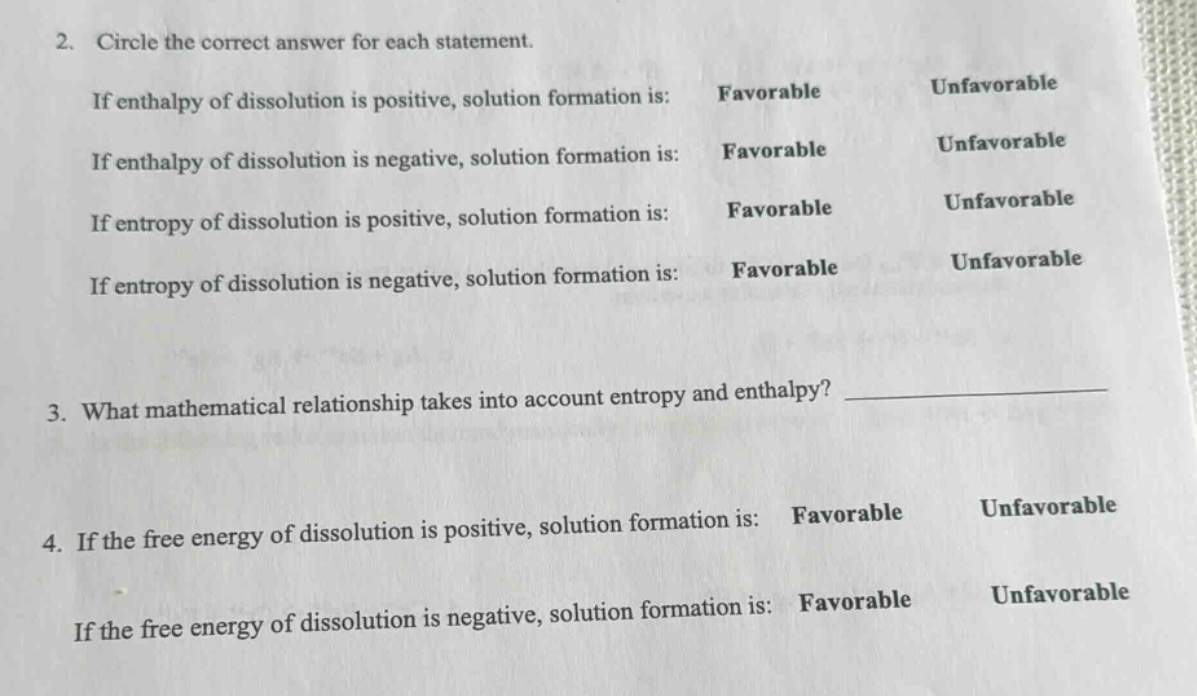
2. circle the correct answer for each statement. if enthalpy of dissolution is positive, solution formation is: favorable unfavorable if enthalpy of dissolution is negative, solution formation is: favorable unfavorable if entropy of dissolution is positive, solution formation is: favorable unfavorable if entropy of dissolution is negative, solution formation is: favorable unfavorable 3. what mathematical relationship takes into account entropy and enthalpy? 4. if the free energy of dissolution is positive, solution formation is: favorable unfavorable if the free energy of dissolution is negative, solution formation is: favorable unfavorable
Answer
Brief Explanations:
- For enthalpy of dissolution: A positive enthalpy means an endothermic process and is not always favorable for solution - formation. A negative enthalpy (exothermic) is generally favorable. For entropy of dissolution, a positive entropy (more disorder) is favorable and a negative entropy (less disorder) is unfavorable.
- The Gibbs - free energy equation $G = H - TS$ (or $\Delta G=\Delta H - T\Delta S$ for changes) takes into account both enthalpy ($H$) and entropy ($S$).
- For free energy of dissolution, a positive $\Delta G$ means the process is non - spontaneous (unfavorable) and a negative $\Delta G$ means the process is spontaneous (favorable).
Answer:
- If enthalpy of dissolution is positive, solution formation is: Unfavorable If enthalpy of dissolution is negative, solution formation is: Favorable If entropy of dissolution is positive, solution formation is: Favorable If entropy of dissolution is negative, solution formation is: Unfavorable
- $\Delta G=\Delta H - T\Delta S$
- If the free energy of dissolution is positive, solution formation is: Unfavorable If the free energy of dissolution is negative, solution formation is: Favorable