the colligative effects of 1 molal sugar solution would be ? 1 molal sodium chloride solution.\n\n1. greater…
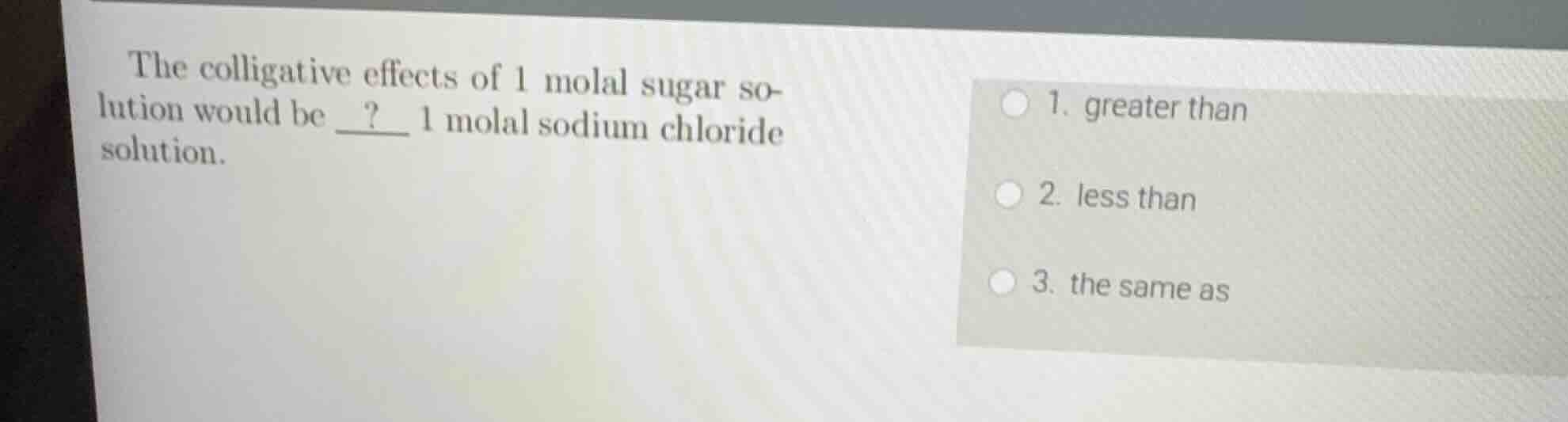
the colligative effects of 1 molal sugar solution would be ? 1 molal sodium chloride solution.\n\n1. greater than\n2. less than\n3. the same as
Answer
Explanation:
Step1: Identify the nature of the solutes
Sugar (sucrose) is a non-electrolyte that does not dissociate in water, meaning its van't Hoff factor is $i = 1$.
Step2: Identify the dissociation of sodium chloride
Sodium chloride ($NaCl$) is a strong electrolyte that dissociates into two ions ($Na^{+}$ and $Cl^{-}$), resulting in a van't Hoff factor of $i = 2$.
Step3: Compare the effective particle concentrations
Colligative properties depend on the total concentration of solute particles. For 1 molal solutions: Effective concentration of sugar = $1 \times 1 = 1\text{ molal}$ Effective concentration of $NaCl$ = $1 \times 2 = 2\text{ molal}$
Step4: Determine the relative magnitude
Since the effective particle concentration of the sugar solution is lower than that of the $NaCl$ solution, its colligative effects are smaller.
Answer:
- less than