compound a reacts with compound b to form only one product, compound c, and its known the usual percent…
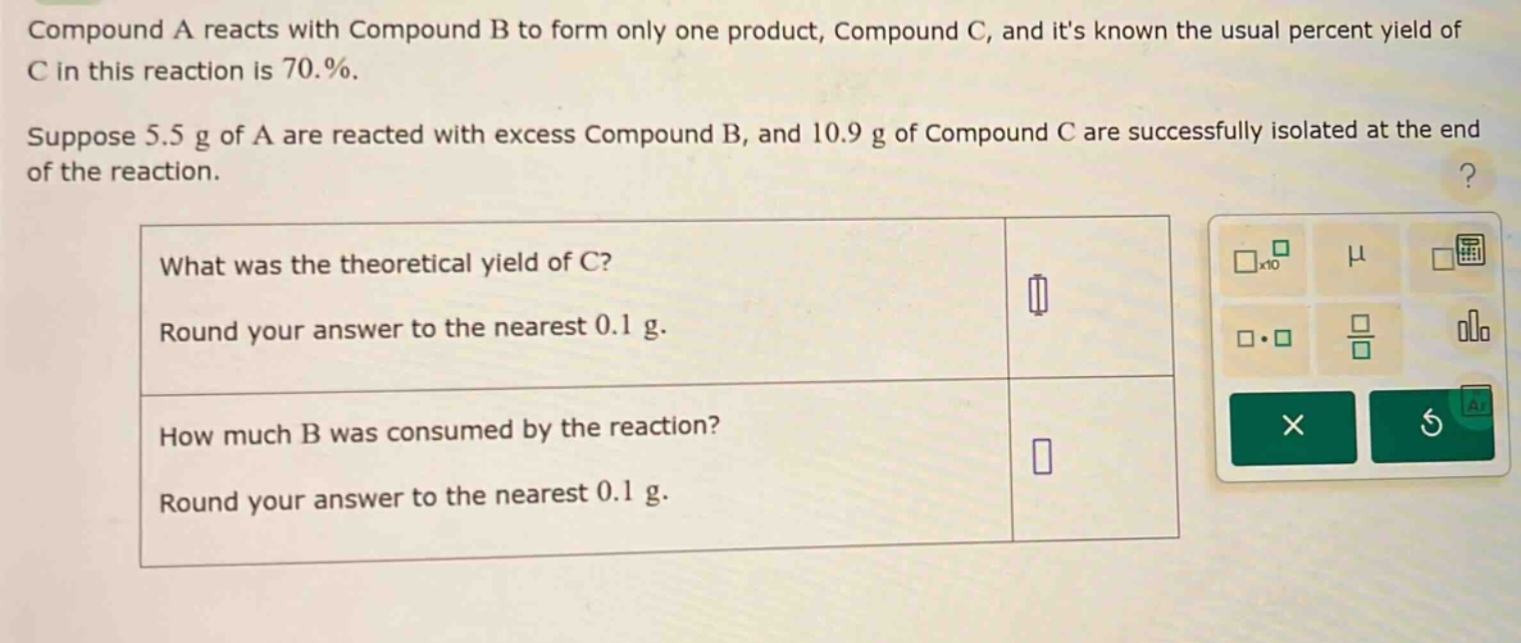
compound a reacts with compound b to form only one product, compound c, and its known the usual percent yield of c in this reaction is 70.%. suppose 5.5 g of a are reacted with excess compound b, and 10.9 g of compound c are successfully isolated at the end of the reaction. what was the theoretical yield of c? round your answer to the nearest 0.1 g. how much b was consumed by the reaction? round your answer to the nearest 0.1 g.
Answer
Explanation:
Step1: Recall percent - yield formula
Percent yield = $\frac{\text{actual yield}}{\text{theoretical yield}}\times100%$. We know percent yield = 70.0% and actual yield of C = 10.9 g. Let the theoretical yield of C be $x$. Then $70.0=\frac{10.9}{x}\times100$.
Step2: Solve for theoretical yield of C
First, rewrite the equation as $0.7=\frac{10.9}{x}$. Cross - multiply to get $0.7x = 10.9$. Then $x=\frac{10.9}{0.7}\approx15.6$ g.
Since we are not given the balanced chemical equation and molar masses of A, B and C, we cannot calculate the amount of B consumed.
Answer:
What was the theoretical yield of C? 15.6 g How much B was consumed by the reaction? Insufficient information