what is the concentration of solution?\nknow how to calculate percent by mass and volume. write down both…
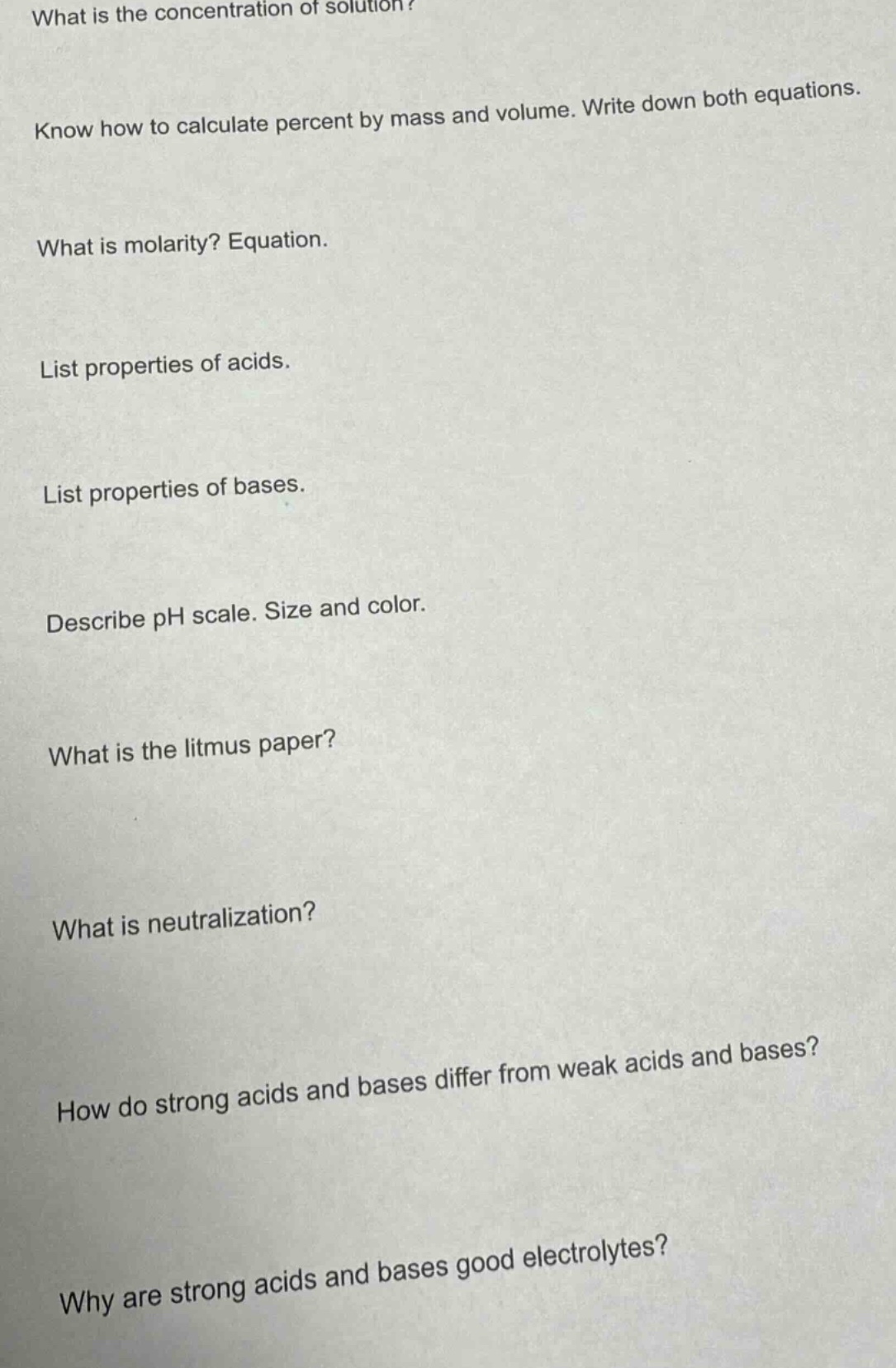
what is the concentration of solution?\nknow how to calculate percent by mass and volume. write down both equations.\nwhat is molarity? equation.\nlist properties of acids.\nlist properties of bases.\ndescribe ph scale. size and color.\nwhat is the litmus paper?\nwhat is neutralization?\nhow do strong acids and bases differ from weak acids and bases?\nwhy are strong acids and bases good electrolytes?
Answer
Explanation:
Step1: Concentration by mass formula
Percent - by - mass=$\frac{\text{mass of solute}}{\text{mass of solution}}\times100%$
Step2: Concentration by volume formula
Percent - by - volume=$\frac{\text{volume of solute}}{\text{volume of solution}}\times100%$
Step3: Molarity formula
Molarity ($M$)=$\frac{\text{moles of solute}}{\text{liters of solution}}$
Step4: Properties of acids
- Taste sour.
- React with metals to produce hydrogen gas.
- Turn blue litmus paper red.
- Conduct electricity in solution.
Step5: Properties of bases
- Taste bitter.
- Feel slippery.
- Turn red litmus paper blue.
- Conduct electricity in solution.
Step6: pH scale description
- Ranges from 0 - 14.
- pH of 7 is neutral, below 7 is acidic, above 7 is basic.
- Color - indicators like litmus paper or pH paper change color based on pH.
Step7: Litmus paper description
- A type of pH - indicator paper.
- Blue litmus paper turns red in acidic solutions.
- Red litmus paper turns blue in basic solutions.
Step8: Neutralization description
A chemical reaction between an acid and a base that produces a salt and water.
Step9: Difference between strong and weak acids/bases
- Strong acids and bases completely dissociate in solution, weak ones only partially dissociate.
Step10: Why strong acids and bases are good electrolytes
They completely dissociate in solution, producing a high concentration of ions which can conduct electricity.
Answer:
Concentration by mass: Percent - by - mass=$\frac{\text{mass of solute}}{\text{mass of solution}}\times100%$; Concentration by volume: Percent - by - volume=$\frac{\text{volume of solute}}{\text{volume of solution}}\times100%$; Molarity: Molarity ($M$)=$\frac{\text{moles of solute}}{\text{liters of solution}}$; Properties of acids: Taste sour, react with metals to produce hydrogen gas, turn blue litmus paper red, conduct electricity in solution; Properties of bases: Taste bitter, feel slippery, turn red litmus paper blue, conduct electricity in solution; pH scale: Ranges from 0 - 14, 7 is neutral, below 7 is acidic, above 7 is basic, color - indicators change color based on pH; Litmus paper: A pH - indicator paper, blue turns red in acid, red turns blue in base; Neutralization: A reaction between an acid and a base producing a salt and water; Difference between strong and weak acids/bases: Strong ones completely dissociate, weak ones partially dissociate; Why strong acids and bases are good electrolytes: They completely dissociate, producing many ions for conduction.