concept questions:\n1. does the addition of water (baking soda + water) alter the ph of weak acids/bases…
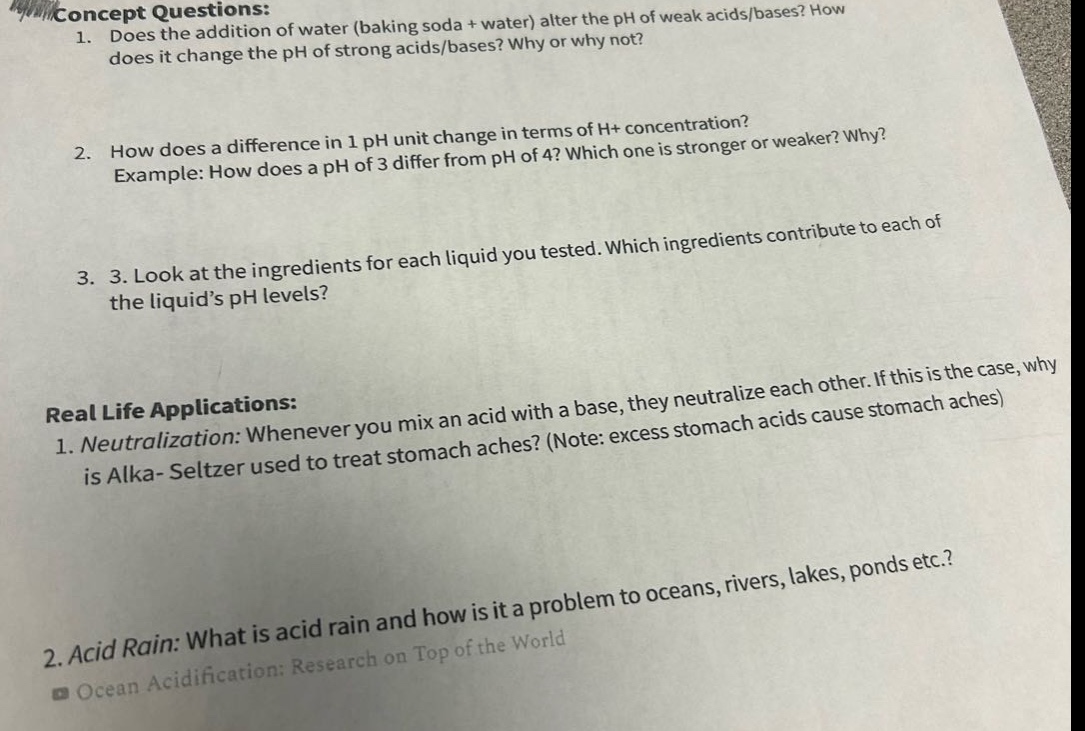
concept questions:\n1. does the addition of water (baking soda + water) alter the ph of weak acids/bases? how does it change the ph of strong acids/bases? why or why not?\n2. how does a difference in 1 ph unit change in terms of h+ concentration? example: how does a ph of 3 differ from ph of 4? which one is stronger or weaker? why?\n3. look at the ingredients for each liquid you tested. which ingredients contribute to each of the liquid’s ph levels?\nreal life applications:\n1. neutralization: whenever you mix an acid with a base, they neutralize each other. if this is the case, why is alka - seltzer used to treat stomach aches? (note: excess stomach acids cause stomach aches)\n2. acid rain: what is acid rain and how is it a problem to oceans, rivers, lakes, ponds etc.?\nocean acidification: research on top of the world
Answer
Explanation:
Concept Questions 1:
For weak acids/bases:
The addition of a basic solution (baking - soda + water) will react with the acidic species in weak acids or the basic species in weak bases. For a weak acid $HA\rightleftharpoons H^++A^-$, the added $OH^-$ from baking - soda (sodium bicarbonate hydrolysis: $HCO_3^- + H_2O\rightleftharpoons H_2CO_3+OH^-$) will react with $H^+$, shifting the equilibrium to the right, increasing the concentration of the conjugate base $A^-$ and increasing the pH. For a weak base $B + H_2O\rightleftharpoons BH^++OH^-$, the added $H^+$ (from the reaction of $HCO_3^-$ with water to release $H^+$ in some cases) or the dilution effect can cause a change in the equilibrium and thus the pH. When adding water to strong acids/bases, it dilutes the concentration of $H^+$ (for acids) or $OH^-$ (for bases). For a strong acid $HA\rightarrow H^++A^-$, if the initial volume is $V_1$ and the number of moles of $H^+$ is $n$, the initial $[H^+]_1=\frac{n}{V_1}$. After adding volume $V_2$ of water, $[H^+]_2=\frac{n}{V_1 + V_2}$, so the pH increases (since $pH=-\log[H^+]$). For a strong base $BOH\rightarrow B^++OH^-$, dilution decreases $[OH^-]$, increases $[H^+]=\frac{K_w}{[OH^-]}$ and thus decreases the pH.
Concept Questions 2:
The pH is defined as $pH = -\log[H^+]$. If $pH_1=-\log[H^+]_1$ and $pH_2=-\log[H^+]_2$, and $|pH_1 - pH_2| = 1$. Let $pH_1<pH_2$. Then $-\log[H^+]_1+\log[H^+]_2=- 1$, or $\log\frac{[H^+]_2}{[H^+]_1}=-1$, so $\frac{[H^+]_2}{[H^+]_1}=0.1$. A pH of 3 has a $[H^+]=10^{-3}\ M$ and a pH of 4 has a $[H^+]=10^{-4}\ M$. The solution with pH = 3 is more acidic (stronger in terms of acid - strength) because it has a higher $H^+$ concentration.
Concept Questions 3:
For acidic liquids, ingredients like citric acid in lemon juice contribute to the low pH as it dissociates to release $H^+$ ions ($C_6H_8O_7\rightleftharpoons H^++C_6H_7O_7^-$). For basic liquids, ingredients like sodium bicarbonate in baking - soda solution contribute to the high pH as it hydrolyzes to produce $OH^-$ ions ($HCO_3^-+H_2O\rightleftharpoons H_2CO_3 + OH^-$).
Real - Life Applications 1:
Alka - Seltzer contains sodium bicarbonate ($NaHCO_3$) and citric acid ($C_6H_8O_7$). When added to water, they react. The sodium bicarbonate acts as a base and neutralizes the excess stomach acid (hydrochloric acid, $HCl$). The reaction is $NaHCO_3+HCl\rightarrow NaCl + H_2O+CO_2$. This reduces the concentration of $H^+$ in the stomach, relieving the stomach ache caused by excess acid.
Real - Life Applications 2:
Acid rain is rainwater with a pH lower than 5.6. It is mainly caused by the presence of sulfur dioxide ($SO_2$) and nitrogen oxides ($NO_x$) in the atmosphere. These pollutants react with water, oxygen and other substances in the atmosphere to form sulfuric acid ($H_2SO_4$) and nitric acid ($HNO_3$). In aquatic systems like oceans, rivers, lakes and ponds, acid rain can lower the pH of the water. This can be harmful to aquatic organisms. For example, many fish and invertebrates have a narrow pH tolerance range. A decrease in pH can affect their physiological functions, such as respiration, reproduction and osmoregulation. It can also cause the release of toxic metals like aluminum from the soil into the water, which is harmful to aquatic life.
Answer:
- For weak acids/bases, baking - soda + water can react with acidic/basic species and change pH. For strong acids/bases, water dilutes $H^+$ or $OH^-$ and changes pH.
- A difference of 1 pH unit means a ten - fold difference in $H^+$ concentration. pH = 3 is stronger (more acidic) than pH = 4.
- Acidic ingredients like citric acid lower pH, basic ingredients like sodium bicarbonate raise pH.
- Alka - Seltzer contains a base that neutralizes excess stomach acid.
- Acid rain is rain with pH < 5.6, formed from $SO_2$ and $NO_x$ reactions. It harms aquatic life by lowering water pH and releasing toxic metals.