consider the chemical equation.\n\ncucl₂ + 2nano₃ → cu(no₃)₂ + 2nacl\n\nwhat is the percent yield of nacl if…
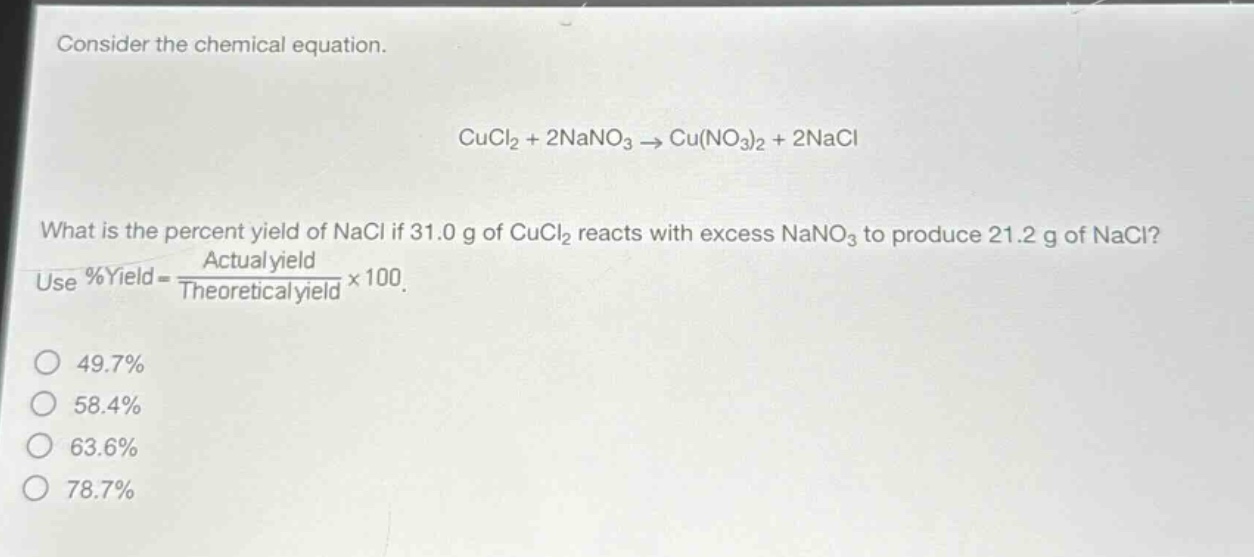
consider the chemical equation.\n\ncucl₂ + 2nano₃ → cu(no₃)₂ + 2nacl\n\nwhat is the percent yield of nacl if 31.0 g of cucl₂ reacts with excess nano₃ to produce 21.2 g of nacl?\nuse %yield = \\frac{actual yield}{theoretical yield}×100.\n\n49.7%\n58.4%\n63.6%\n78.7%
Answer
Explanation:
Step1: Calculate molar mass of CuCl₂
The molar mass of Cu (copper) is approximately 63.55 g/mol and of Cl (chlorine) is approximately 35.45 g/mol. For CuCl₂, molar mass $M_{CuCl_2}=63.55 + 2\times35.45=134.45$ g/mol.
Step2: Calculate moles of CuCl₂
Given mass of CuCl₂ is $m_{CuCl_2} = 31.0$ g. Moles of CuCl₂, $n_{CuCl_2}=\frac{m_{CuCl_2}}{M_{CuCl_2}}=\frac{31.0}{134.45}\approx0.231$ mol.
Step3: Determine moles of NaCl from stoichiometry
From the balanced chemical equation $CuCl_2 + 2NaNO_3\rightarrow Cu(NO_3)2+2NaCl$, the mole - ratio of $CuCl_2$ to $NaCl$ is 1:2. So moles of NaCl produced theoretically, $n{NaCl - theoretical}=2\times n_{CuCl_2}=2\times0.231 = 0.462$ mol.
Step4: Calculate theoretical mass of NaCl
The molar mass of NaCl is $M_{NaCl}=22.99 + 35.45=58.44$ g/mol. Theoretical mass of NaCl, $m_{NaCl - theoretical}=n_{NaCl - theoretical}\times M_{NaCl}=0.462\times58.44\approx27.0$ g.
Step5: Calculate percent - yield of NaCl
Actual yield of NaCl is $m_{NaCl - actual}=21.2$ g. Percent - yield $=\frac{m_{NaCl - actual}}{m_{NaCl - theoretical}}\times100=\frac{21.2}{27.0}\times100\approx78.5% \approx 78.7%$ (rounding difference).
Answer:
D. 78.7%