consider the chemical equation in equilibrium.\n\n$$a(g) + 2b(g) \\rightleftharpoons c(g) + d(g) +…
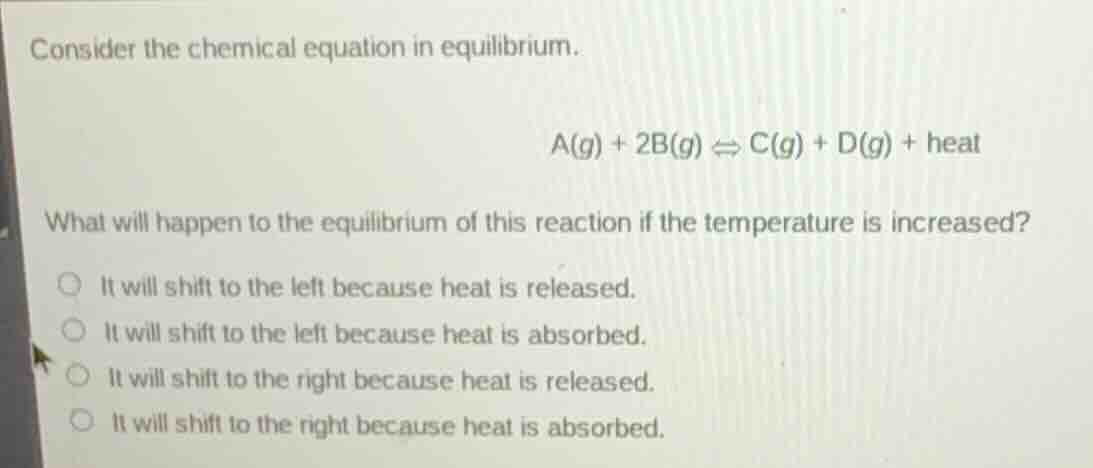
consider the chemical equation in equilibrium.\n\n$$a(g) + 2b(g) \\rightleftharpoons c(g) + d(g) + \\text{heat}$$\n\nwhat will happen to the equilibrium of this reaction if the temperature is increased?\n\n- it will shift to the left because heat is released.\n- it will shift to the left because heat is absorbed.\n- it will shift to the right because heat is released.\n- it will shift to the right because heat is absorbed.
Answer
Explanation:
Step1: Identify the reaction type
The equation $A(g) + 2B(g) \rightleftharpoons C(g) + D(g) + \text{heat}$ shows heat as a product, indicating an exothermic reaction.
Step2: Apply Le Chatelier's Principle
Increasing temperature adds heat to the system, causing a shift to consume the excess heat.
Step3: Determine the shift direction
The equilibrium shifts to the left (reactant side) to absorb heat via the endothermic reverse reaction.
Answer:
It will shift to the left because heat is absorbed.