consider the chlorotrioxyl (clo₃⁺) cation.\nwhat is the central atom? enter its chemical symbol.\nhow many…
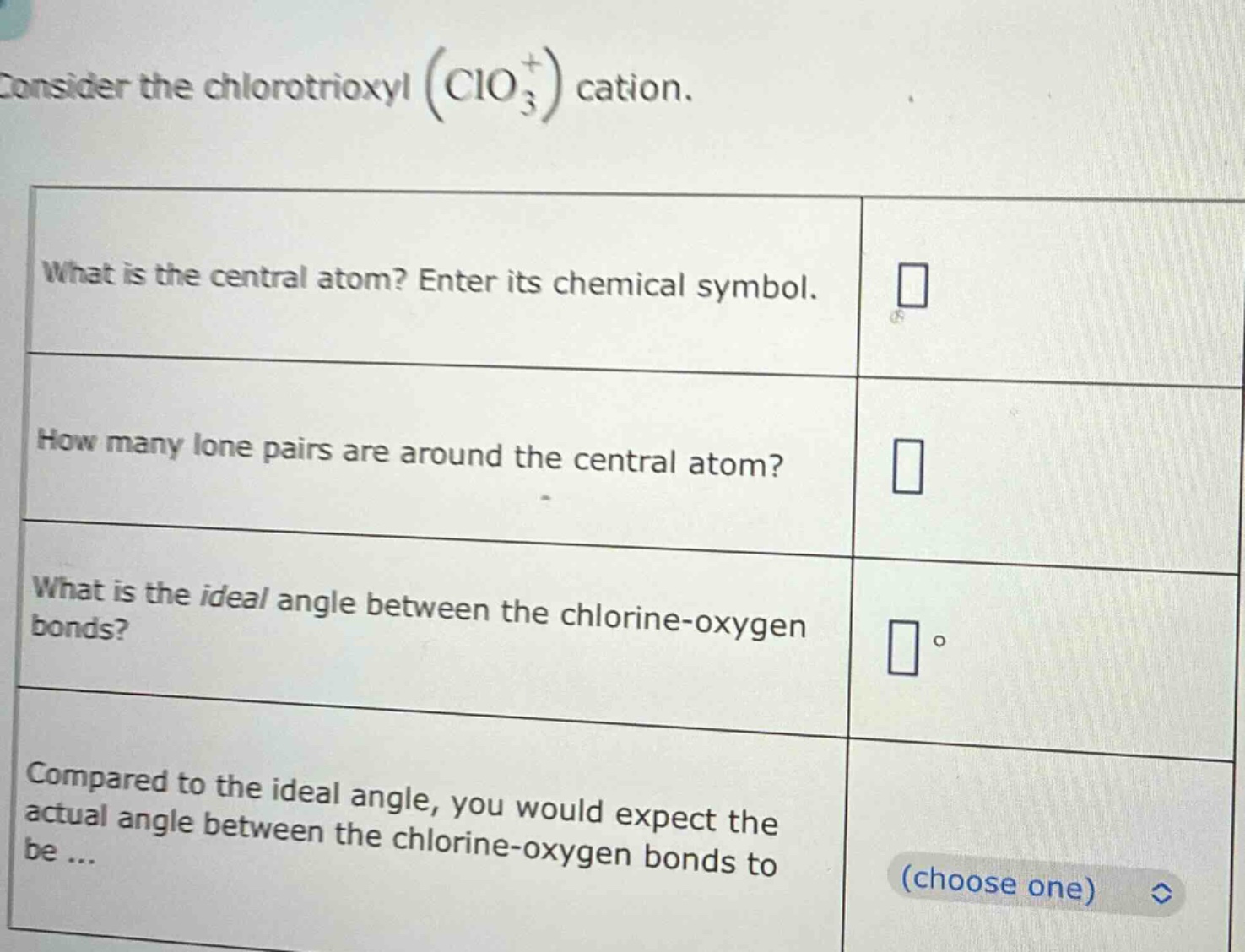
consider the chlorotrioxyl (clo₃⁺) cation.\nwhat is the central atom? enter its chemical symbol.\nhow many lone pairs are around the central atom?\nwhat is the ideal angle between the chlorine - oxygen bonds?\ncompared to the ideal angle, you would expect the actual angle between the chlorine - oxygen bonds to be ... (choose one)
Answer
Explanation:
Step1: Identify central atom
In $ClO_3^+$, chlorine is the central atom as oxygen is more electronegative and usually terminal.
Step2: Calculate lone - pairs
Chlorine has 7 valence electrons. In $ClO_3^+$, it has a + 1 charge. So the number of available valence electrons for bonding is 6. It forms 3 double - bonds with oxygen atoms. Using the formula for lone - pairs $V - \frac{B}{2}$, where $V$ is the number of valence electrons and $B$ is the number of bonding electrons. Here $V = 6$ and $B=6$ (3 double - bonds), so the number of lone - pairs is 0.
Step3: Determine ideal bond angle
With 3 bonding pairs and 0 lone - pairs around the central atom, the electron - pair geometry is trigonal planar. The ideal bond angle for a trigonal planar geometry is 120°.
Step4: Compare actual and ideal bond angles
Since there are no lone - pairs to cause repulsion, the actual bond angle is equal to the ideal bond angle.
Answer:
- Cl
- 0
- 120
- equal to the ideal angle