consider the equation for the formation of water.\n\n2h₂ + o₂ → 2h₂o\n\nwhat is the theoretical yield of h₂o…
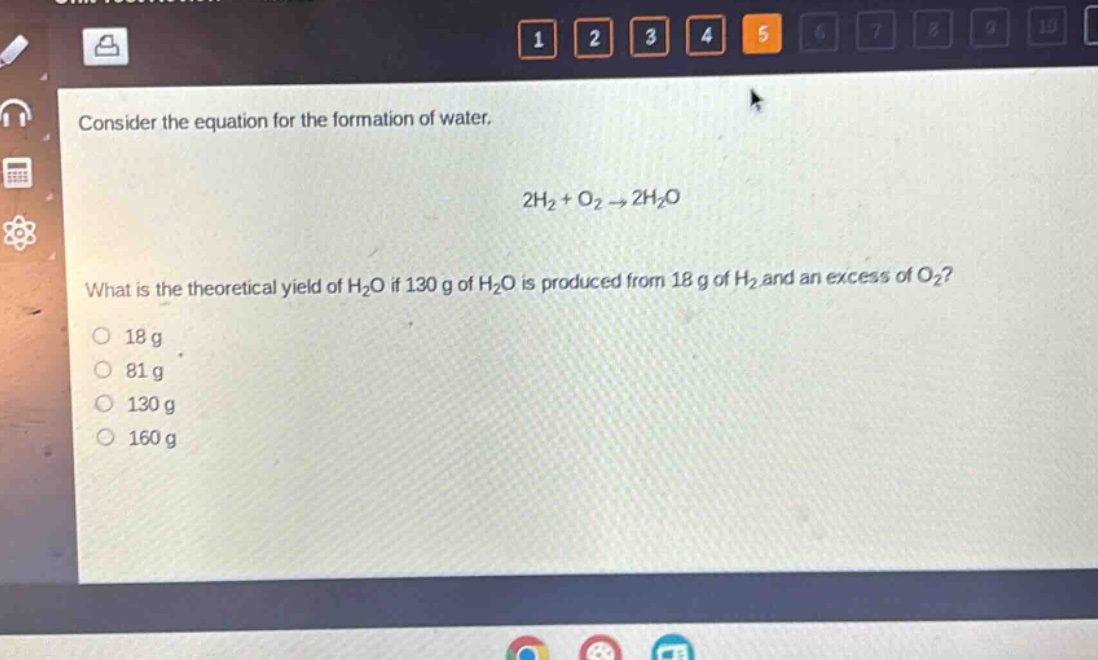
consider the equation for the formation of water.\n\n2h₂ + o₂ → 2h₂o\n\nwhat is the theoretical yield of h₂o if 130 g of h₂o is produced from 18 g of h₂ and an excess of o₂?\n\n18 g\n81 g\n130 g\n160 g
Answer
Explanation:
Step1: Determine molar - masses
The molar mass of $H_2$ is $M_{H_2}=2\times1\ g/mol = 2\ g/mol$, and the molar mass of $H_2O$ is $M_{H_2O}=2\times1 + 16=18\ g/mol$.
Step2: Calculate moles of $H_2$
The number of moles of $H_2$, $n_{H_2}=\frac{m_{H_2}}{M_{H_2}}=\frac{18\ g}{2\ g/mol}=9\ mol$.
Step3: Use stoichiometry
From the balanced equation $2H_2 + O_2\rightarrow2H_2O$, the mole - ratio of $H_2$ to $H_2O$ is 1:1. So, the number of moles of $H_2O$ produced from 9 mol of $H_2$ is also $n_{H_2O}=9\ mol$.
Step4: Calculate theoretical yield of $H_2O$
The mass of $H_2O$, $m_{H_2O}=n_{H_2O}\times M_{H_2O}=9\ mol\times18\ g/mol = 162\ g\approx160\ g$ (due to rounding in multiple - choice options).
Answer:
D. 160 g