consider the equilibrium system below.\n\n$nh_{4}cl(s) \rightleftharpoons nh_{4}cl(g)$\n\nif the system is…
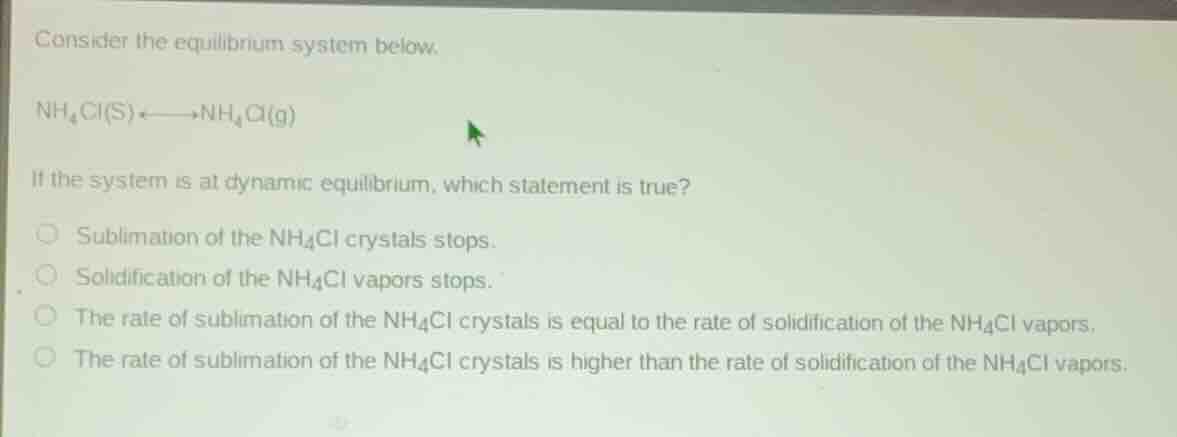
consider the equilibrium system below.\n\n$nh_{4}cl(s) \rightleftharpoons nh_{4}cl(g)$\n\nif the system is at dynamic equilibrium, which statement is true?\n\nsublimation of the $nh_{4}cl$ crystals stops.\nsolidification of the $nh_{4}cl$ vapors stops.\nthe rate of sublimation of the $nh_{4}cl$ crystals is equal to the rate of solidification of the $nh_{4}cl$ vapors.\nthe rate of sublimation of the $nh_{4}cl$ crystals is higher than the rate of solidification of the $nh_{4}cl$ vapors.
Answer
Explanation:
Step1: Define dynamic equilibrium
Dynamic equilibrium occurs when forward and reverse processes happen at equal rates.
Step2: Identify the phase changes
The forward process is sublimation ($s \rightarrow g$) and the reverse is solidification ($g \rightarrow s$).
Step3: Apply equilibrium condition
At equilibrium, the rate of sublimation must equal the rate of solidification. $$Rate_{sublimation} = Rate_{solidification}$$
Answer:
The rate of sublimation of the $NH_{4}Cl$ crystals is equal to the rate of solidification of the $NH_{4}Cl$ vapors.