consider the following intermediate chemical equations.\n2na(s)+cl₂(g)→2nacl(s)\n2na₂o(s)→4na(s)+o₂(g)\nin…
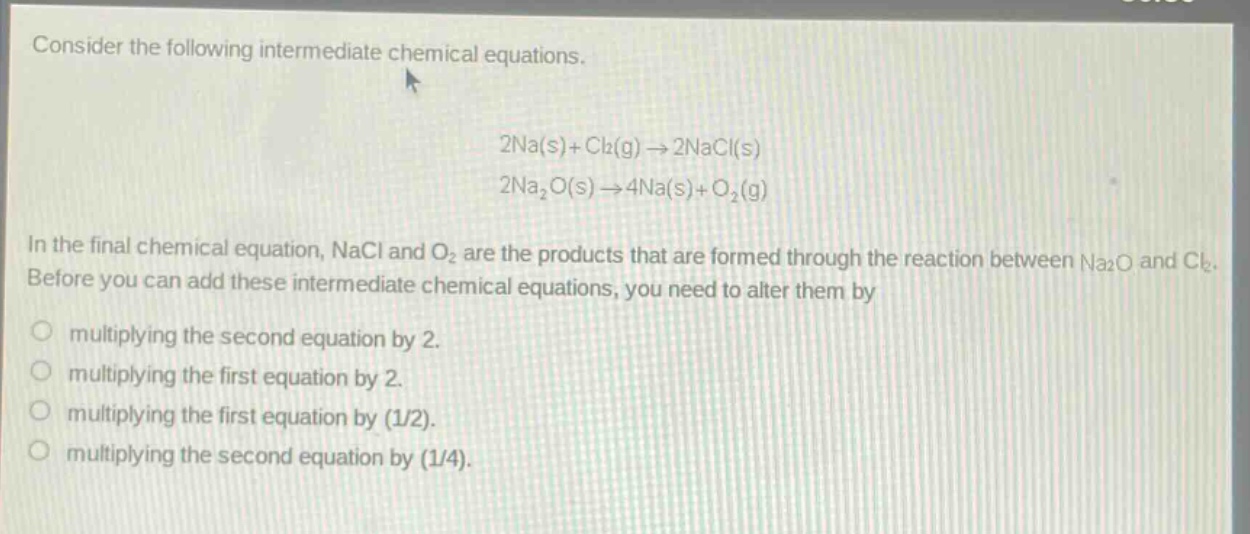
consider the following intermediate chemical equations.\n2na(s)+cl₂(g)→2nacl(s)\n2na₂o(s)→4na(s)+o₂(g)\nin the final chemical equation, nacl and o₂ are the products that are formed through the reaction between na₂o and cl₂. before you can add these intermediate chemical equations, you need to alter them by\nmultiplying the second equation by 2.\nmultiplying the first equation by 2.\nmultiplying the first equation by (1/2).\nmultiplying the second equation by (1/4).
Answer
Explanation:
Step1: Analyze the target reaction
The target reaction involves the reaction between $Na_2O$ and $Cl_2$ to form $NaCl$ and $O_2$. The intermediate equations are: Equation 1: $2Na(s)+Cl_2(g)\rightarrow2NaCl(s)$ Equation 2: $2Na_2O(s)\rightarrow4Na(s)+O_2(g)$ We want to cancel out the $Na$ intermediate.
Step2: Adjust the equations for $Na$ - cancellation
In Equation 1, we have $2Na$ on the left - hand side and in Equation 2, we have $4Na$ on the right - hand side. To cancel out the $Na$ terms when we add the two equations, we need to make the number of $Na$ atoms the same in both equations. If we multiply Equation 1 by 2, we get $4Na(s)+2Cl_2(g)\rightarrow4NaCl(s)$. Now when we add this new Equation 1 to Equation 2, the $Na$ terms will cancel out.
Answer:
multiplying the first equation by 2.