consider the following intermediate chemical equations.\n c(s)+\frac{1}{2}o_2(g)\rightarrow co(g) \n…
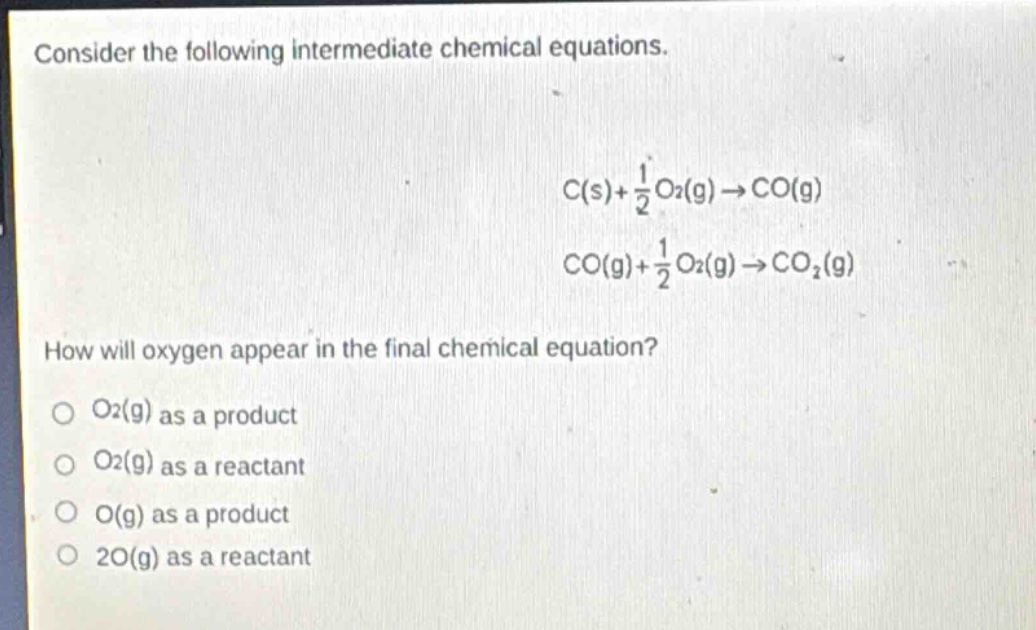
consider the following intermediate chemical equations.\n c(s)+\frac{1}{2}o_2(g)\rightarrow co(g) \n co(g)+\frac{1}{2}o_2(g)\rightarrow co_2(g) \nhow will oxygen appear in the final chemical equation?\no (o_2(g)) as a product\no (o_2(g)) as a reactant\no (o(g)) as a product\no (2o(g)) as a reactant
Answer
Explanation:
Step1: Add the two given equations
Add $C(s)+\frac{1}{2}O_2(g)\rightarrow CO(g)$ and $CO(g)+\frac{1}{2}O_2(g)\rightarrow CO_2(g)$. $C(s)+\frac{1}{2}O_2(g)+CO(g)+\frac{1}{2}O_2(g)\rightarrow CO(g)+CO_2(g)$
Step2: Simplify the equation
Cancel out the $CO(g)$ on both sides. $C(s)+O_2(g)\rightarrow CO_2(g)$
Answer:
B. $O_2(g)$ as a reactant