consider the reaction au(oh)₃ + hi → au + i₂ + h₂o. label the half - reactions as oxidation (use “o”) or…
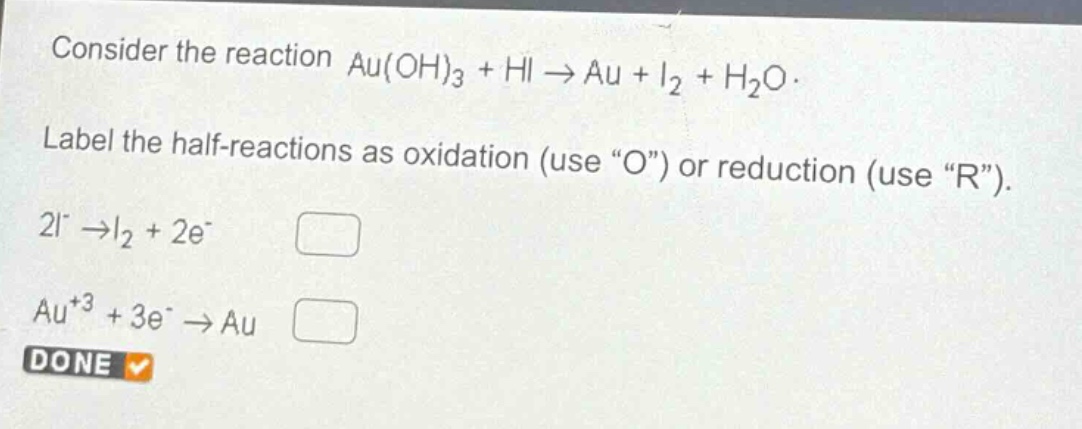
consider the reaction au(oh)₃ + hi → au + i₂ + h₂o. label the half - reactions as oxidation (use “o”) or reduction (use “r”). 2i⁻ → i₂ + 2e⁻ au⁺³ + 3e⁻ → au done
Answer
Explanation:
Step1: Understand oxidation - loss of electrons
Oxidation is a process where a species loses electrons. In the reaction $2I^-\to I_2 + 2e^-$, the iodide ion ($I^-$) loses electrons to form iodine ($I_2$). So this is an oxidation reaction.
Step2: Understand reduction - gain of electrons
Reduction is a process where a species gains electrons. In the reaction $Au^{+3}+3e^-\to Au$, the gold(III) ion ($Au^{+3}$) gains electrons to form elemental gold ($Au$). So this is a reduction reaction.
Answer:
$2I^-\to I_2 + 2e^-$: O $Au^{+3}+3e^-\to Au$: R