consider the reaction.\nzn(s)+2hcl(aq)→zncl₂(aq)+h₂(g)\nwhich statement is true at stp? (the atomic mass of…
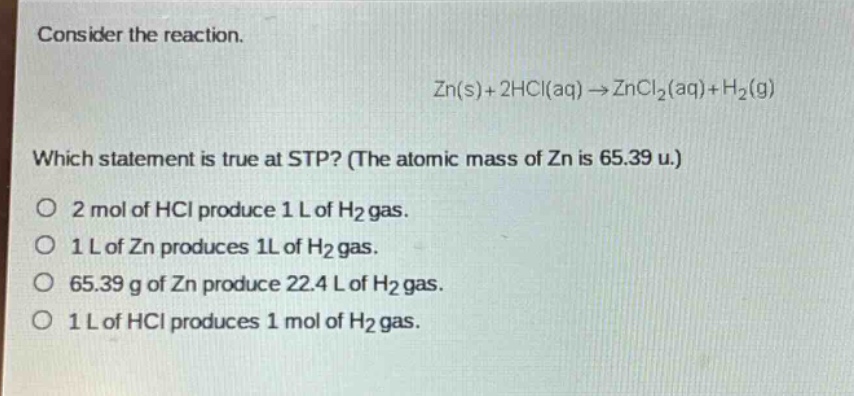
consider the reaction.\nzn(s)+2hcl(aq)→zncl₂(aq)+h₂(g)\nwhich statement is true at stp? (the atomic mass of zn is 65.39 u.)\no 2 mol of hcl produce 1 l of h₂ gas.\no 1 l of zn produces 1 l of h₂ gas.\no 65.39 g of zn produce 22.4 l of h₂ gas.\no 1 l of hcl produces 1 mol of h₂ gas.
Answer
Explanation:
Step1: Recall molar volume at STP
At STP (Standard Temperature and Pressure, 0°C and 1 atm), 1 mole of any ideal - gas occupies 22.4 L.
Step2: Analyze the balanced chemical equation
The balanced equation is (Zn(s)+2HCl(aq)\rightarrow ZnCl_{2}(aq) + H_{2}(g)). The mole - ratio of (Zn) to (H_{2}) is 1:1. The molar mass of (Zn) is 65.39 g/mol. So, 1 mole of (Zn) (65.39 g) reacts to produce 1 mole of (H_{2}) gas. Since 1 mole of (H_{2}) gas occupies 22.4 L at STP, 65.39 g of (Zn) produce 22.4 L of (H_{2}) gas.
Step3: Analyze other options
- For the reaction, 2 moles of (HCl) produce 1 mole of (H_{2}) gas. At STP, 1 mole of (H_{2}) gas is 22.4 L, not 1 L. So, "2 mol of (HCl) produce 1 L of (H_{2}) gas" is false.
- (Zn) is a solid, and we cannot use volume - to - volume relationships for solids and gases in the same way as for gases. So, "1 L of (Zn) produces 1 L of (H_{2}) gas" is false.
- (HCl) is in aqueous solution, and we cannot directly relate its volume to the moles of (H_{2}) gas produced without knowing its concentration. So, "1 L of (HCl) produces 1 mol of (H_{2}) gas" is false.
Answer:
65.39 g of Zn produce 22.4 L of (H_{2}) gas.