consider the redox reaction below.\nmg(s) + fe^{2+}(aq)→mg^{2+}(aq) + fe(s)\nwhich equation is a half…
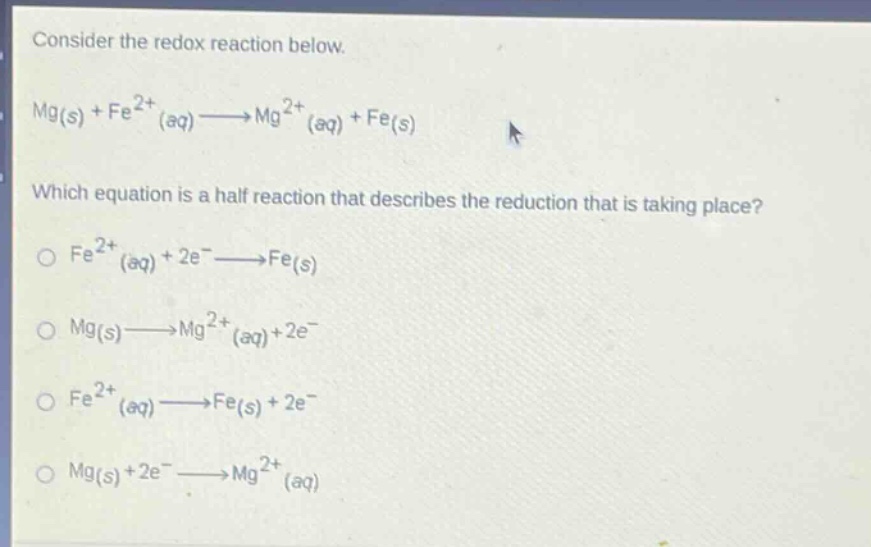
consider the redox reaction below.\nmg(s) + fe^{2+}(aq)→mg^{2+}(aq) + fe(s)\nwhich equation is a half - reaction that describes the reduction that is taking place?\no fe^{2+}(aq)+2e^ - →fe(s)\no mg(s)→mg^{2+}(aq)+2e^ - \no fe^{2+}(aq)→fe(s)+2e^ - \no mg(s)+2e^ - →mg^{2+}(aq)
Answer
Explanation:
Step1: Understand reduction concept
Reduction is gain of electrons.
Step2: Analyze each option
In the reaction $\text{Mg}(s)+\text{Fe}^{2 +}(aq)\longrightarrow\text{Mg}^{2 +}(aq)+\text{Fe}(s)$, iron(II) ion $\text{Fe}^{2 +}$ gains 2 electrons to form iron metal $\text{Fe}$. The half - reaction for this reduction is $\text{Fe}^{2 +}(aq)+2\text{e}^{-}\longrightarrow\text{Fe}(s)$. The other options represent oxidation of magnesium or incorrect electron - transfer for iron.
Answer:
$\text{Fe}^{2 +}(aq)+2\text{e}^{-}\longrightarrow\text{Fe}(s)$