consider the redox reaction below.\nmg(s) + fe²⁺(aq) → mg²⁺(aq) + fe(s)\nwhich equation is a half - reaction…
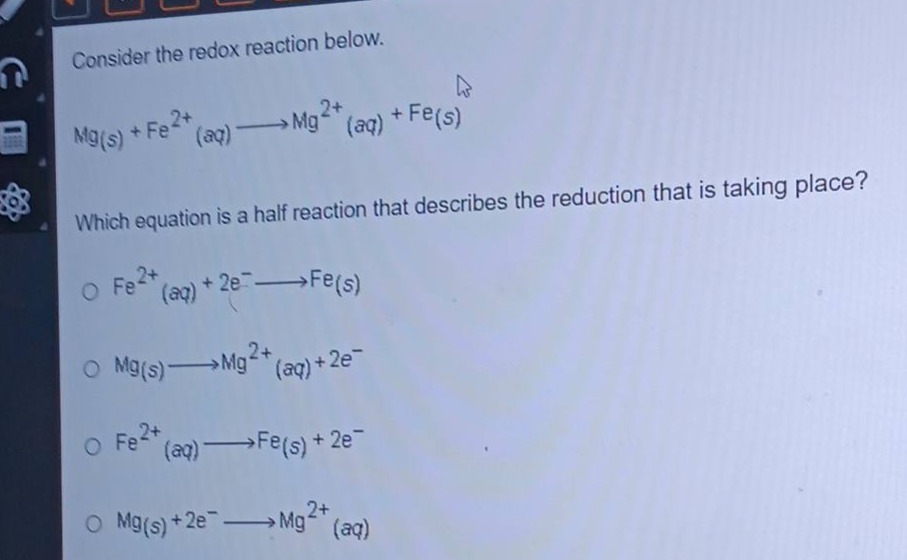
consider the redox reaction below.\nmg(s) + fe²⁺(aq) → mg²⁺(aq) + fe(s)\nwhich equation is a half - reaction that describes the reduction that is taking place?\no fe²⁺(aq) + 2e⁻ → fe(s)\no mg(s) → mg²⁺(aq) + 2e⁻\no fe²⁺(aq) → fe(s) + 2e⁻\no mg(s) + 2e⁻ → mg²⁺(aq)
Answer
Answer:
Fe$^{2 +}$(aq) + 2e$^-$ $\longrightarrow$ Fe(s)
Explanation:
Step1: Define reduction
Reduction is gain of electrons.
Step2: Analyze species
In the reaction Mg(s) + Fe$^{2+}$(aq) $\longrightarrow$ Mg$^{2+}$(aq) + Fe(s), Fe$^{2+}$ gains 2 electrons to become Fe.
Step3: Identify half - reaction
The half - reaction for the reduction of Fe$^{2+}$ is Fe$^{2 +}$(aq) + 2e$^-$ $\longrightarrow$ Fe(s).