covalent bonds generally form when the bonded elements have a difference in electronegativity less than 1.5…
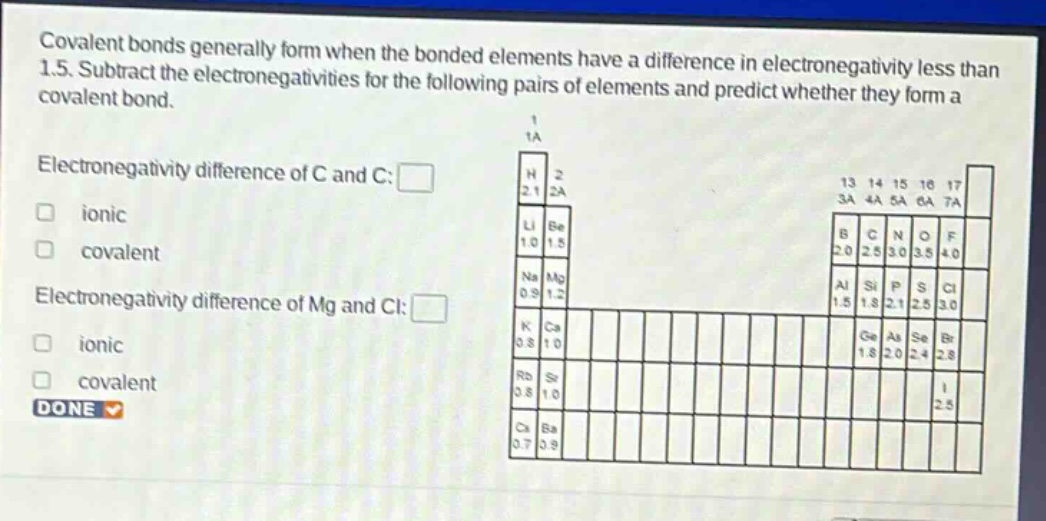
covalent bonds generally form when the bonded elements have a difference in electronegativity less than 1.5. subtract the electronegativities for the following pairs of elements and predict whether they form a covalent bond. electronegativity difference of c and c: □ ionic □ covalent electronegativity difference of mg and cl: □ ionic □ covalent done
Answer
Explanation:
Step1: Find electronegativity of C
The electronegativity of carbon (C) is 2.5.
Step2: Calculate difference for C - C
For two carbon - carbon atoms, the electronegativity difference $\Delta\chi=|2.5 - 2.5|=0$. Since $0<1.5$, it is covalent.
Step3: Find electronegativities of Mg and Cl
The electronegativity of magnesium (Mg) is 1.2 and of chlorine (Cl) is 3.0.
Step4: Calculate difference for Mg - Cl
The electronegativity difference $\Delta\chi=|3.0 - 1.2| = 1.8$. Since $1.8>1.5$, it is ionic.
Answer:
Electronegativity difference of C and C: 0, covalent Electronegativity difference of Mg and Cl: 1.8, ionic