covalent bonds generally form when the bonded elements have a difference in electronegativity less than 1.5…
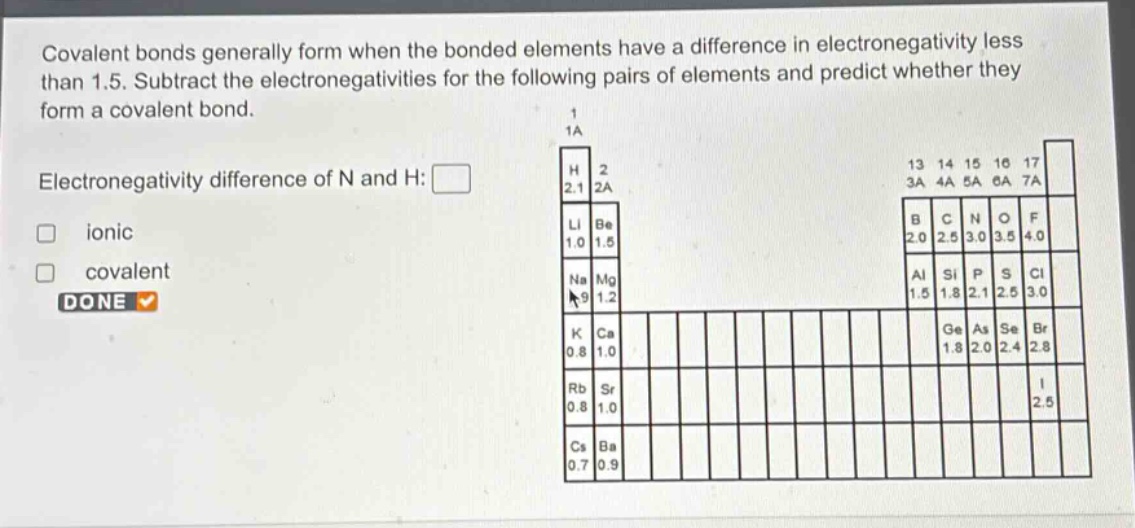
covalent bonds generally form when the bonded elements have a difference in electronegativity less than 1.5. subtract the electronegativities for the following pairs of elements and predict whether they form a covalent bond. \nelectronegativity difference of n and h: \nionic \ncovalent \ndone
Answer
Explanation:
Step1: Find electronegativity values
From the given table, electronegativity of (N = 3.0), electronegativity of (H=2.1)
Step2: Calculate the difference
(\Delta\chi=\vert3.0 - 2.1\vert=0.9) Since (0.9<1.5), the bond is covalent.
Answer:
Electronegativity difference of (N) and (H): (0.9); covalent