decomposition of potassium chlorate (kclo3) produces potassium chloride (kcl) and pure oxygen (o2). the…
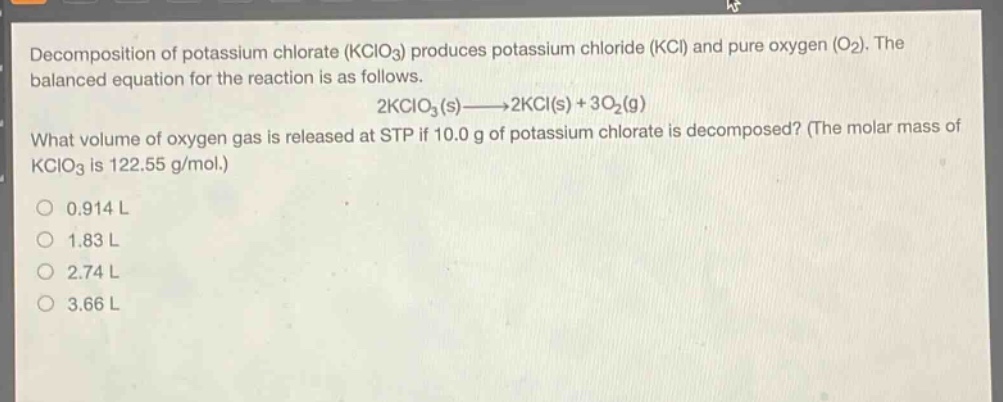
decomposition of potassium chlorate (kclo3) produces potassium chloride (kcl) and pure oxygen (o2). the balanced equation for the reaction is as follows. 2kclo3(s)→2kcl(s)+3o2(g) what volume of oxygen gas is released at stp if 10.0 g of potassium chlorate is decomposed? (the molar mass of kclo3 is 122.55 g/mol.) 0.914 l 1.83 l 2.74 l 3.66 l
Answer
Explanation:
Step1: Calculate moles of KClO₃
$n_{KClO_3}=\frac{m}{M}=\frac{10.0\ g}{122.55\ g/mol}\approx0.0816\ mol$
Step2: Determine moles of O₂ from stoichiometry
From the balanced equation $2KClO_3(s)\longrightarrow2KCl(s) + 3O_2(g)$, the mole - ratio of $KClO_3$ to $O_2$ is 2:3. So $n_{O_2}=\frac{3}{2}n_{KClO_3}=\frac{3}{2}\times0.0816\ mol = 0.1224\ mol$
Step3: Calculate volume of O₂ at STP
At STP, 1 mole of any gas occupies 22.4 L. So $V_{O_2}=n_{O_2}\times22.4\ L/mol=0.1224\ mol\times22.4\ L/mol\approx2.74\ L$
Answer:
2.74 L