describing homogeneous mixtures\nwhen using a liquid as a solvent, what could be the state(s) of matter of…
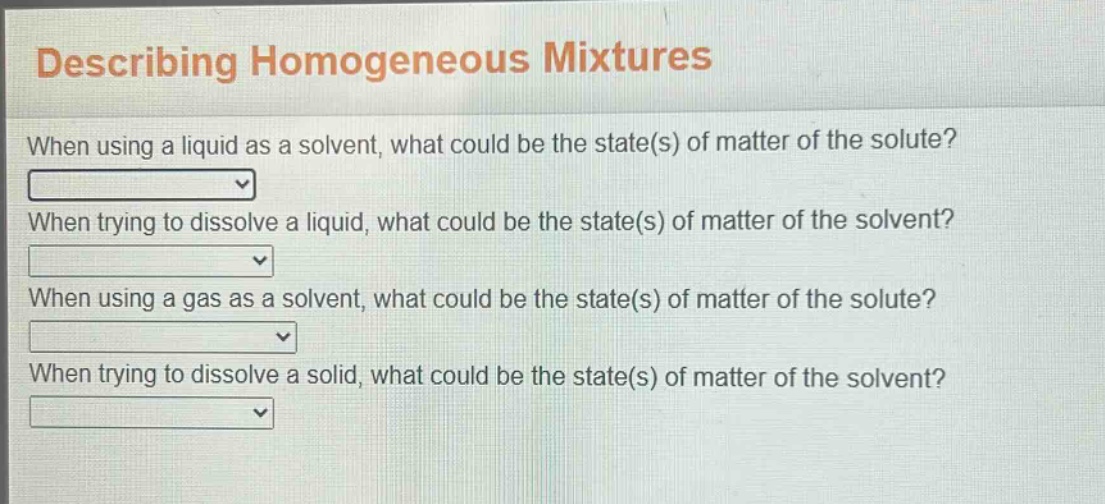
describing homogeneous mixtures\nwhen using a liquid as a solvent, what could be the state(s) of matter of the solute?\nwhen trying to dissolve a liquid, what could be the state(s) of matter of the solvent?\nwhen using a gas as a solvent, what could be the state(s) of matter of the solute?\nwhen trying to dissolve a solid, what could be the state(s) of matter of the solvent?
Answer
Brief Explanations:
- When a liquid is a solvent, a solute can be solid (like salt in water), liquid (like alcohol in water), or gas (like carbon - dioxide in water).
- To dissolve a liquid, the solvent can be liquid (miscible liquids like water and ethanol) or gas (e.g., water vapor dissolving in air).
- When a gas is a solvent, the solute can be gas (e.g., oxygen in nitrogen in air), liquid (e.g., water vapor in air), or solid (e.g., tiny dust particles in air).
- To dissolve a solid, the solvent can be liquid (like water dissolving sugar), gas (e.g., iodine subliming into air), or supercritical fluid.
Answer:
- Solid, Liquid, Gas
- Liquid, Gas
- Solid, Liquid, Gas
- Liquid, Gas