determine the number of particles in the 2.56 mol sample of no2.\n1 mol no2 = 6.02 x 10^23 particles…
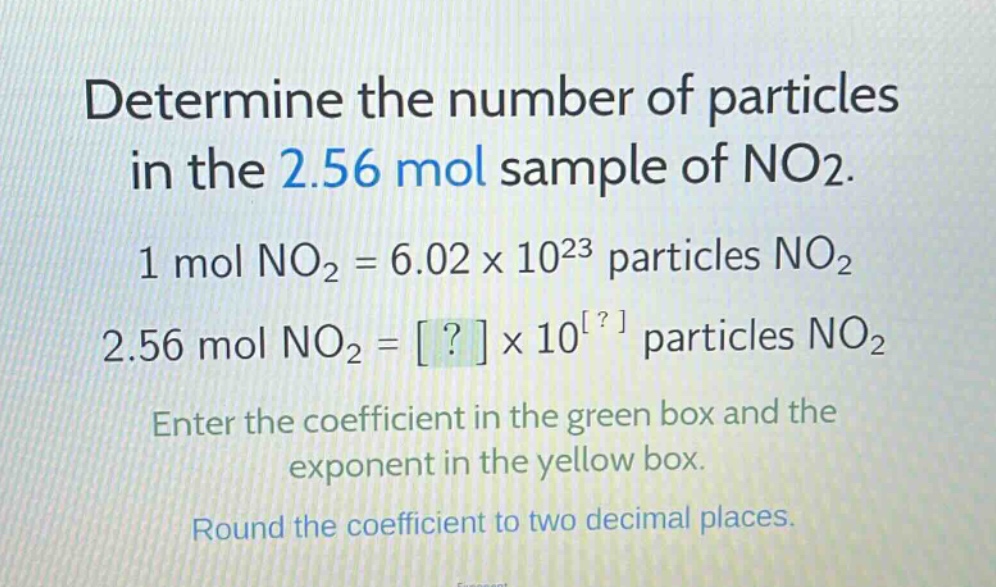
determine the number of particles in the 2.56 mol sample of no2.\n1 mol no2 = 6.02 x 10^23 particles no2\n2.56 mol no2 = ? x 10^? particles no2\nenter the coefficient in the green box and the exponent in the yellow box.\nround the coefficient to two decimal places.
Answer
Explanation:
Step1: Use Avogadro's number
We know that 1 mol of any substance contains $6.02\times 10^{23}$ particles. To find the number of particles in 2.56 mol of $NO_2$, we multiply the number of moles by Avogadro's number. $N = n\times N_A$, where $n = 2.56$ mol and $N_A=6.02\times 10^{23}$ particles/mol. $N=2.56\times6.02\times 10^{23}$
Step2: Calculate the product
$2.56\times6.02 = 15.4112$. So $N = 15.4112\times 10^{23}$. In scientific - notation, this is $1.54112\times 10^{24}$. Rounding the coefficient to two decimal places, we get $1.54\times 10^{24}$.
Answer:
Coefficient: 1.54, Exponent: 24