determine the number of particles in the 1.95 mol sample of sf6.\n1 mol sf6 = 6.02×10²³ particles sf6\n1.95…
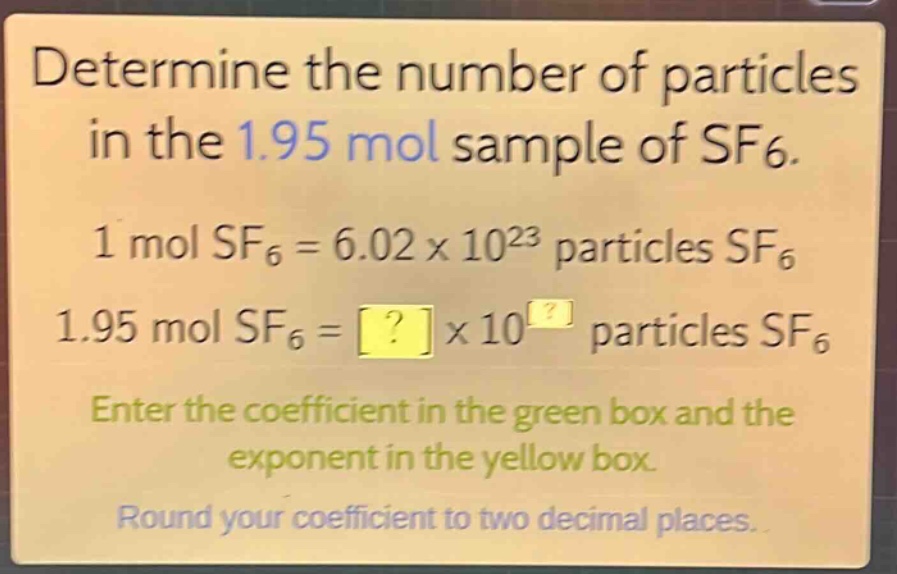
determine the number of particles in the 1.95 mol sample of sf6.\n1 mol sf6 = 6.02×10²³ particles sf6\n1.95 mol sf6 = ?×10^? particles sf6\nenter the coefficient in the green box and the exponent in the yellow box.\nround your coefficient to two decimal places.
Answer
Answer:
Coefficient: 11.74, Exponent: 23
Explanation:
Step1: Set up the proportion
We know that 1 mol of $SF_6$ has $6.02\times 10^{23}$ particles. Let $x$ be the number of particles in 1.95 mol of $SF_6$. The proportion is $\frac{x}{1.95\ mol}=\frac{6.02\times 10^{23}\ particles}{1\ mol}$.
Step2: Solve for $x$
$x = 1.95\times6.02\times 10^{23}$ particles. Calculate $1.95\times6.02 = 11.739$. Rounding to two - decimal places, we get 11.74. So $x=11.74\times 10^{23}$ particles.