determine the simplest form of a compound made up of carbon, hydrogen, nitrogen, and oxygen if it is made of…
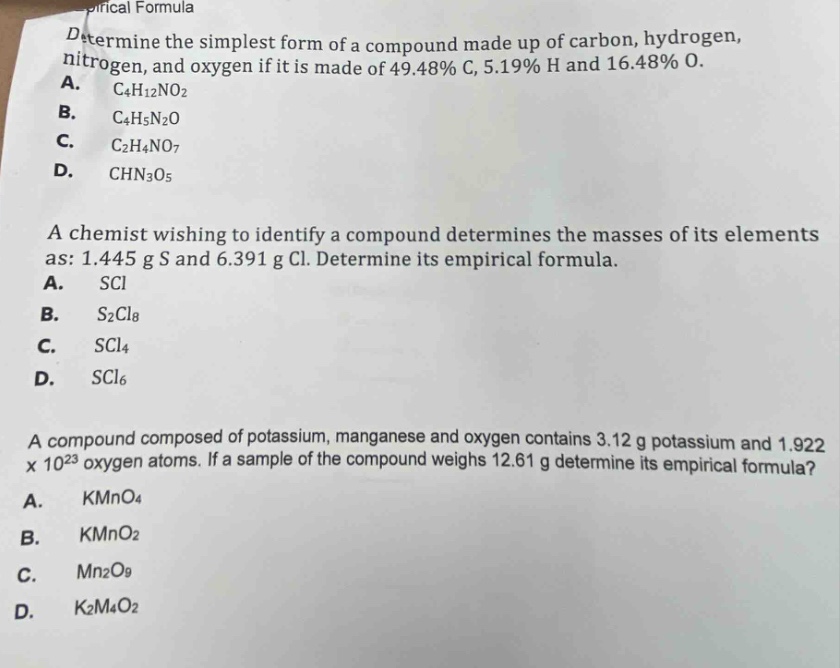
determine the simplest form of a compound made up of carbon, hydrogen, nitrogen, and oxygen if it is made of 49.48% c, 5.19% h and 16.48% o.\na. c4h12no2\nb. c4h5n2o\nc. c2h4no7\nd. chn3o5\n\na chemist wishing to identify a compound determines the masses of its elements as: 1.445 g s and 6.391 g cl. determine its empirical formula.\na. sci\nb. s2cl8\nc. scl4\nd. scl6\n\na compound composed of potassium, manganese and oxygen contains 3.12 g potassium and 1.922 x 10^23 oxygen atoms. if a sample of the compound weighs 12.61 g determine its empirical formula?\na. kmno4\nb. kmno2\nc. mn2o9\nd. k2m4o2
Answer
First Question
Explanation:
Step1: Calculate the percentage of nitrogen
The sum of the percentages of all elements in a compound is 100%. So the percentage of nitrogen ($N$) is $100-(49.48 + 5.19+16.48)=28.85%$.
Step2: Assume 100g of the compound
If we assume 100g of the compound, then the masses of $C = 49.48g$, $H=5.19g$, $N = 28.85g$, $O=16.48g$.
Step3: Calculate the number of moles of each element
The molar - mass of $C$ is $M_{C}=12g/mol$, $H$ is $M_{H}=1g/mol$, $N$ is $M_{N}=14g/mol$, $O$ is $M_{O}=16g/mol$. The number of moles of $C$: $n_{C}=\frac{49.48g}{12g/mol}\approx4.12mol$. The number of moles of $H$: $n_{H}=\frac{5.19g}{1g/mol}=5.19mol$. The number of moles of $N$: $n_{N}=\frac{28.85g}{14g/mol}\approx2.06mol$. The number of moles of $O$: $n_{O}=\frac{16.48g}{16g/mol}=1.03mol$.
Step4: Find the mole - ratio of the elements
Divide each number of moles by the smallest number of moles ($n_{O} = 1.03mol$). $C:\frac{4.12}{1.03}=4$, $H:\frac{5.19}{1.03}=5$, $N:\frac{2.06}{1.03}=2$, $O:\frac{1.03}{1.03}=1$. The empirical formula is $C_{4}H_{5}N_{2}O$.
Answer:
B. $C_{4}H_{5}N_{2}O$
Second Question
Explanation:
Step1: Calculate the number of moles of each element
The molar - mass of $S$ is $M_{S}=32g/mol$ and the molar - mass of $Cl$ is $M_{Cl}=35.5g/mol$. The number of moles of $S$: $n_{S}=\frac{1.445g}{32g/mol}\approx0.045mol$. The number of moles of $Cl$: $n_{Cl}=\frac{6.391g}{35.5g/mol}\approx0.18mol$.
Step2: Find the mole - ratio of the elements
Divide each number of moles by the smallest number of moles ($n_{S}=0.045mol$). $\frac{n_{Cl}}{n_{S}}=\frac{0.18mol}{0.045mol}=4$, $\frac{n_{S}}{n_{S}} = 1$. The empirical formula is $SCl_{4}$.
Answer:
C. $SCl_{4}$
Third Question
Explanation:
Step1: Calculate the number of moles of potassium
The molar - mass of $K$ is $M_{K}=39g/mol$. The number of moles of $K$: $n_{K}=\frac{3.12g}{39g/mol}=0.08mol$.
Step2: Calculate the number of moles of oxygen
We know that $1$ mole of any substance contains $N_{A}=6.022\times 10^{23}$ atoms. The number of moles of $O$: $n_{O}=\frac{1.922\times 10^{23}}{6.022\times 10^{23}mol^{-1}} = 0.32mol$.
Step3: Calculate the mass of manganese
The mass of the compound is $m = 12.61g$. The mass of $Mn$ is $m_{Mn}=12.61g - 3.12g-(0.32mol\times16g/mol)=12.61g - 3.12g - 5.12g = 4.37g$. The molar - mass of $Mn$ is $M_{Mn}=55g/mol$. The number of moles of $Mn$: $n_{Mn}=\frac{4.37g}{55g/mol}\approx0.08mol$.
Step4: Find the mole - ratio of the elements
Divide each number of moles by the smallest number of moles ($n_{K}=n_{Mn}=0.08mol$). For $K$: $\frac{n_{K}}{0.08mol}=1$, for $Mn$: $\frac{n_{Mn}}{0.08mol}=1$, for $O$: $\frac{n_{O}}{0.08mol}=4$. The empirical formula is $KMnO_{4}$.
Answer:
A. $KMnO_{4}$