? determine and write the formula for each of the following polyatomic ionic compounds.\nremember to write…
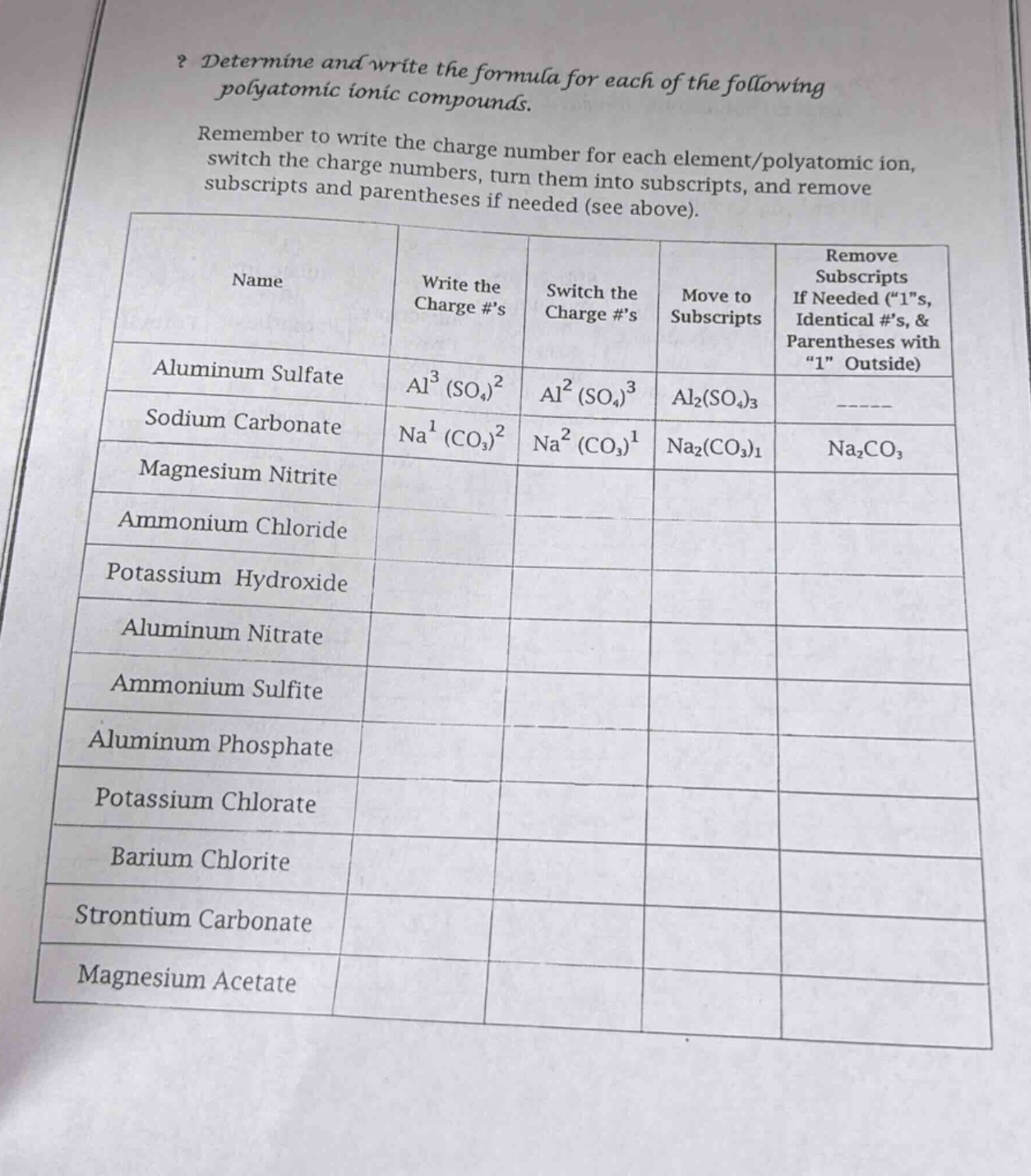
? determine and write the formula for each of the following polyatomic ionic compounds.\nremember to write the charge number for each element/polyatomic ion, switch the charge numbers, turn them into subscripts, and remove subscripts and parentheses if needed (see above).\n\n| name | write the charge #s | switch the charge #s | move to subscripts | remove subscripts if needed (\1\s, identical #s, & parentheses with \1\ outside) |\n| ---- | ---- | ---- | ---- | ---- |\n| aluminum sulfate | $al^{3}(so_{4})^{2}$ | $al^{2}(so_{4})^{3}$ | $al_{2}(so_{4})_{3}$ | ---- |\n| sodium carbonate | $na^{1}(co_{3})^{2}$ | $na^{2}(co_{3})^{1}$ | $na_{2}(co_{3})_{1}$ | $na_{2}co_{3}$ |\n| magnesium nitrite | | | | |\n| ammonium chloride | | | | |\n| potassium hydroxide | | | | |\n| aluminum nitrate | | | | |\n| ammonium sulfite | | | | |\n| aluminum phosphate | | | | |\n| potassium chlorate | | | | |\n| barium chlorite | | | | |\n| strontium carbonate | | | | |\n| magnesium acetate | | | | |
Answer
Explanation:
Step1: Identify ion charges
Magnesium ion ($Mg$) has a charge of $2+$ and nitrite ion ($NO_2$) has a charge of $1 -$.
Step2: Switch charge numbers
We get $Mg^1(NO_2)^2$.
Step3: Move to subscripts
The formula becomes $Mg(NO_2)_2$.
Step4: Remove unnecessary parts
No "1"s, identical numbers or parentheses with "1" outside to remove.
For ammonium chloride:
Step1: Identify ion charges
Ammonium ion ($NH_4$) has a charge of $1+$ and chloride ion ($Cl$) has a charge of $1 -$.
Step2: Switch charge numbers
We get $NH_4^1Cl^1$.
Step3: Move to subscripts
The formula is $NH_4Cl$.
Step4: Remove unnecessary parts
No "1"s, identical numbers or parentheses with "1" outside to remove.
For potassium hydroxide:
Step1: Identify ion charges
Potassium ion ($K$) has a charge of $1+$ and hydroxide ion ($OH$) has a charge of $1 -$.
Step2: Switch charge numbers
We get $K^1(OH)^1$.
Step3: Move to subscripts
The formula is $KOH$.
Step4: Remove unnecessary parts
No "1"s, identical numbers or parentheses with "1" outside to remove.
For aluminum nitrate:
Step1: Identify ion charges
Aluminum ion ($Al$) has a charge of $3+$ and nitrate ion ($NO_3$) has a charge of $1 -$.
Step2: Switch charge numbers
We get $Al^1(NO_3)^3$.
Step3: Move to subscripts
The formula becomes $Al(NO_3)_3$.
Step4: Remove unnecessary parts
No "1"s, identical numbers or parentheses with "1" outside to remove.
For ammonium sulfite:
Step1: Identify ion charges
Ammonium ion ($NH_4$) has a charge of $1+$ and sulfite ion ($SO_3$) has a charge of $2 -$.
Step2: Switch charge numbers
We get $NH_4^2(SO_3)^1$.
Step3: Move to subscripts
The formula is $(NH_4)_2SO_3$.
Step4: Remove unnecessary parts
No "1"s, identical numbers or parentheses with "1" outside to remove.
For aluminum phosphate:
Step1: Identify ion charges
Aluminum ion ($Al$) has a charge of $3+$ and phosphate ion ($PO_4$) has a charge of $3 -$.
Step2: Switch charge numbers
We get $Al^3(PO_4)^3$.
Step3: Move to subscripts
The formula becomes $AlPO_4$.
Step4: Remove unnecessary parts
Removed identical "3"s.
For potassium chlorate:
Step1: Identify ion charges
Potassium ion ($K$) has a charge of $1+$ and chlorate ion ($ClO_3$) has a charge of $1 -$.
Step2: Switch charge numbers
We get $K^1(ClO_3)^1$.
Step3: Move to subscripts
The formula is $KClO_3$.
Step4: Remove unnecessary parts
No "1"s, identical numbers or parentheses with "1" outside to remove.
For barium chlorite:
Step1: Identify ion charges
Barium ion ($Ba$) has a charge of $2+$ and chlorite ion ($ClO_2$) has a charge of $1 -$.
Step2: Switch charge numbers
We get $Ba^1(ClO_2)^2$.
Step3: Move to subscripts
The formula becomes $Ba(ClO_2)_2$.
Step4: Remove unnecessary parts
No "1"s, identical numbers or parentheses with "1" outside to remove.
For strontium carbonate:
Step1: Identify ion charges
Strontium ion ($Sr$) has a charge of $2+$ and carbonate ion ($CO_3$) has a charge of $2 -$.
Step2: Switch charge numbers
We get $Sr^2(CO_3)^2$.
Step3: Move to subscripts
The formula becomes $SrCO_3$.
Step4: Remove unnecessary parts
Removed identical "2"s.
For magnesium acetate:
Step1: Identify ion charges
Magnesium ion ($Mg$) has a charge of $2+$ and acetate ion ($C_2H_3O_2$) has a charge of $1 -$.
Step2: Switch charge numbers
We get $Mg^1(C_2H_3O_2)^2$.
Step3: Move to subscripts
The formula becomes $Mg(C_2H_3O_2)_2$.
Step4: Remove unnecessary parts
No "1"s, identical numbers or parentheses with "1" outside to remove.
Answer:
| Name | Write the Charge #'s | Switch the Charge #'s | Move to Subscripts | Remove Subscripts If Needed ("1"s, Identical #'s, & Parentheses with "1" Outside) |
|---|---|---|---|---|
| Magnesium Nitrite | $Mg^2(NO_2)^1$ | $Mg^1(NO_2)^2$ | $Mg(NO_2)_2$ | $Mg(NO_2)_2$ |
| Ammonium Chloride | $NH_4^1Cl^1$ | $NH_4^1Cl^1$ | $NH_4Cl$ | $NH_4Cl$ |
| Potassium Hydroxide | $K^1(OH)^1$ | $K^1(OH)^1$ | $KOH$ | $KOH$ |
| Aluminum Nitrate | $Al^3(NO_3)^1$ | $Al^1(NO_3)^3$ | $Al(NO_3)_3$ | $Al(NO_3)_3$ |
| Ammonium Sulfite | $NH_4^1(SO_3)^2$ | $NH_4^2(SO_3)^1$ | $(NH_4)_2SO_3$ | $(NH_4)_2SO_3$ |
| Aluminum Phosphate | $Al^3(PO_4)^3$ | $Al^3(PO_4)^3$ | $AlPO_4$ | $AlPO_4$ |
| Potassium Chlorate | $K^1(ClO_3)^1$ | $K^1(ClO_3)^1$ | $KClO_3$ | $KClO_3$ |
| Barium Chlorite | $Ba^2(ClO_2)^1$ | $Ba^1(ClO_2)^2$ | $Ba(ClO_2)_2$ | $Ba(ClO_2)_2$ |
| Strontium Carbonate | $Sr^2(CO_3)^2$ | $Sr^2(CO_3)^2$ | $SrCO_3$ | $SrCO_3$ |
| Magnesium Acetate | $Mg^2(C_2H_3O_2)^1$ | $Mg^1(C_2H_3O_2)^2$ | $Mg(C_2H_3O_2)_2$ | $Mg(C_2H_3O_2)_2$ |