6. the diagram shows an atom. which statement best explains the structure of the atom? a. the nucleus…
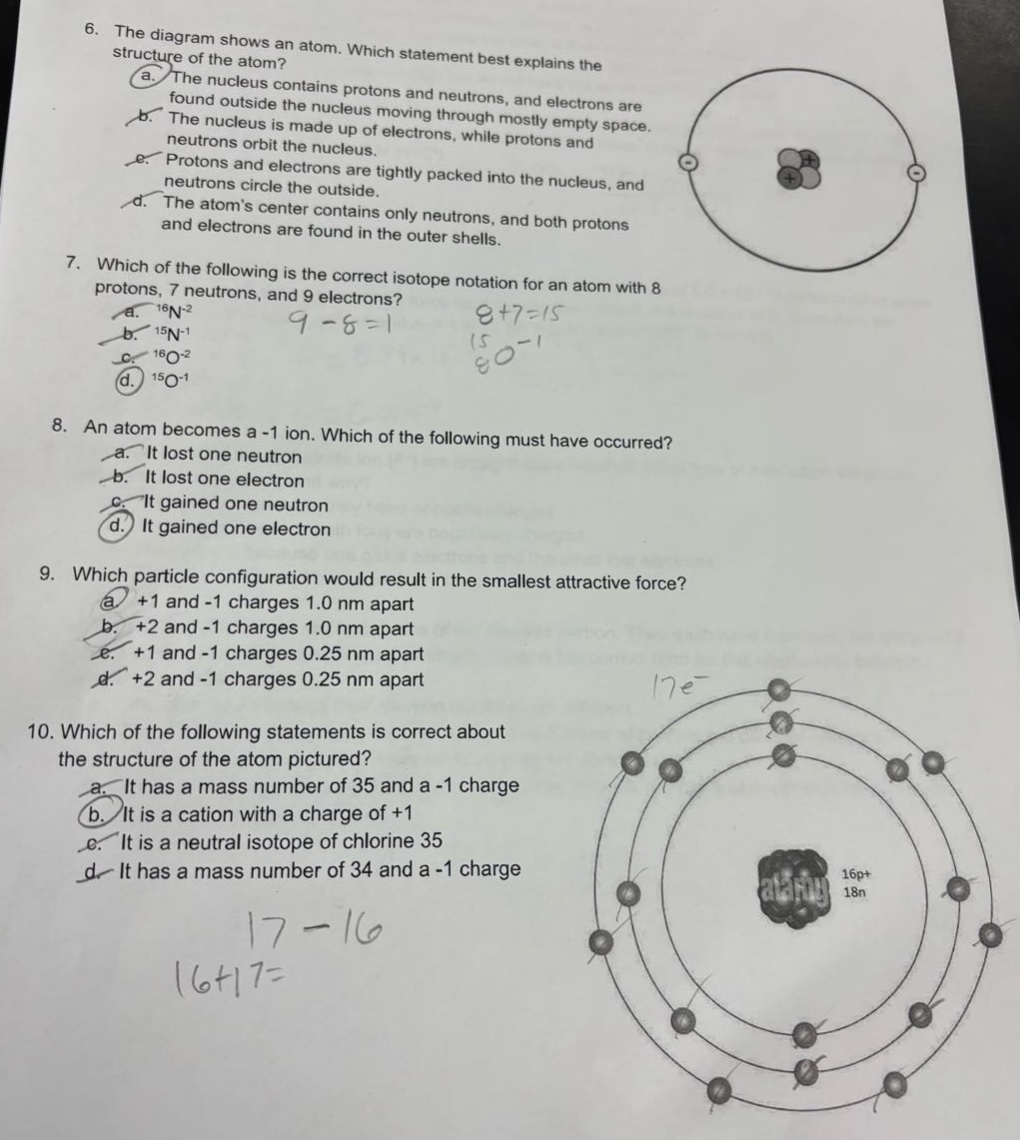
6. the diagram shows an atom. which statement best explains the structure of the atom? a. the nucleus contains protons and neutrons, and electrons are found outside the nucleus moving through mostly empty space. b. the nucleus is made up of electrons, while protons and neutrons orbit the nucleus. c. protons and electrons are tightly packed into the nucleus, and neutrons circle outside. d. the atoms center contains only neutrons, and both protons and electrons are found in the outer shells. 7. which of the following is the correct isotope notation for an atom with 8 protons, 7 neutrons, and 9 electrons? a. $^{16}n^{-2}$ b. $^{15}n^{-1}$ c. $^{16}o^{-2}$ d. $^{15}o^{-1}$ 8. an atom becomes a -1 ion. which of the following must have occurred? a. it lost one neutron b. it lost one electron c. it gained one neutron d. it gained one electron 9. which particle configuration would result in the smallest attractive force? a. +1 and -1 charges 1.0 nm apart b. +2 and -1 charges 1.0 nm apart c. +1 and -1 charges 0.25 nm apart d. +2 and -1 charges 0.25 nm apart 10. which of the following statements is correct about the structure of the atom pictured? a. it has a mass number of 35 and a -1 charge b. it is a cation with a charge of +1 c. it is a neutral isotope of chlorine 35 d. it has a mass number of 34 and a -1 charge
Answer
Explanation:
Step1: Recall atomic - structure basics
The nucleus of an atom contains protons and neutrons, and electrons are found outside the nucleus in mostly empty space. So for question 6, the answer is a.
Step2: Determine isotope notation
The atomic number (Z) is the number of protons, and the mass number (A) is the sum of protons and neutrons. For an atom with 8 protons (oxygen, Z = 8), 7 neutrons (A=8 + 7=15), and 9 electrons (a - 1 charge), the isotope notation is (^{15}O^{-1}). So for question 7, the answer is d.
Step3: Understand ion - formation
An atom becomes a - 1 ion by gaining one electron. Neutrons do not affect the charge of an atom. So for question 8, the answer is d.
Step4: Apply Coulomb's law
Coulomb's law is (F = k\frac{q_1q_2}{r^2}), where (F) is the force, (k) is a constant, (q_1) and (q_2) are charges, and (r) is the distance. The force is directly proportional to the product of the charges and inversely proportional to the square of the distance. The smallest attractive force will be for the smallest product of charges and the largest distance. For question 9, the answer is a.
Step5: Analyze the atom diagram
In the atom diagram, there are 16 protons, 18 neutrons, and 17 electrons. The mass number (A=16 + 18 = 34) and the charge is (16-17=-1). So for question 10, the answer is d.
Answer:
- a. The nucleus contains protons and neutrons, and electrons are found outside the nucleus moving through mostly empty space.
- d. (^{15}O^{-1})
- d. It gained one electron
- a. +1 and -1 charges 1.0 nm apart
- d. It has a mass number of 34 and a - 1 charge