directions (1 - 30): for each statement or question, record on your separate answer sheet the number of the…
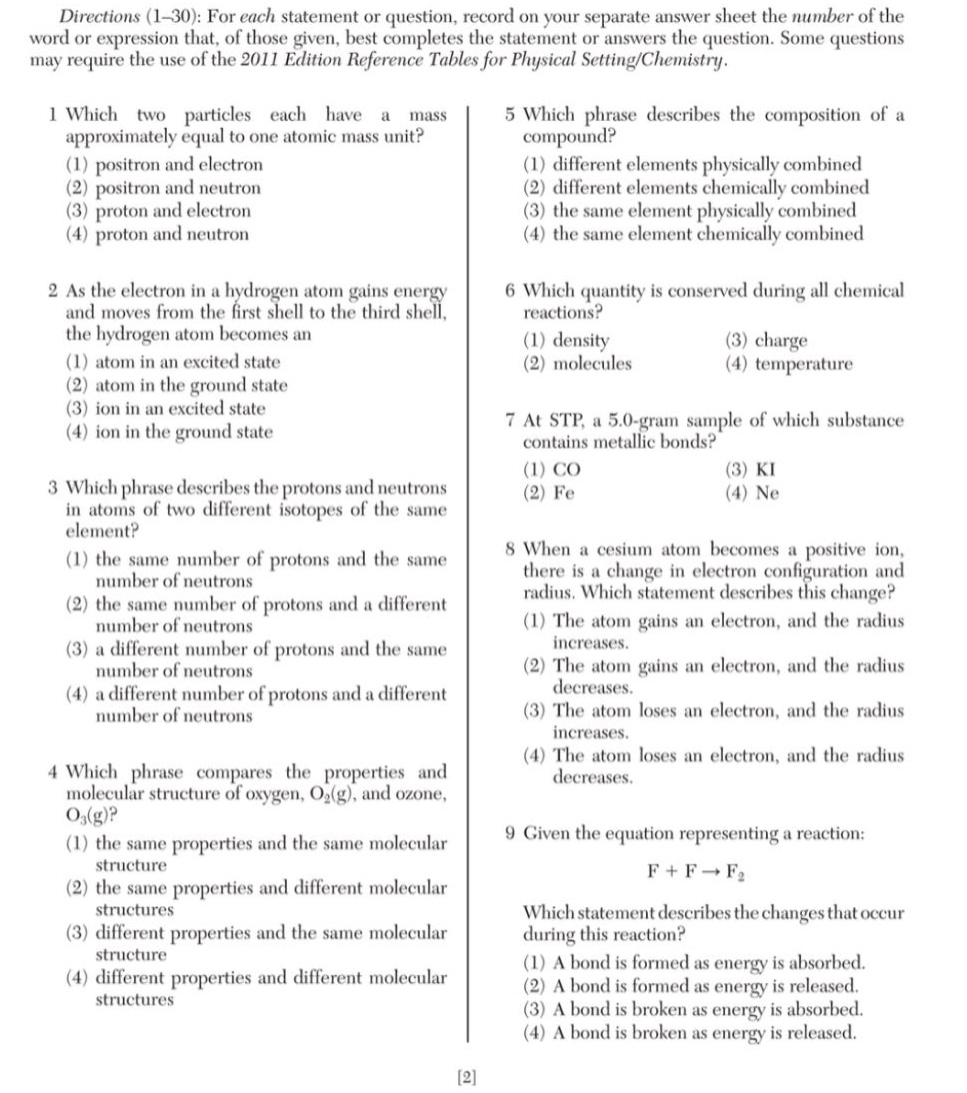
directions (1 - 30): for each statement or question, record on your separate answer sheet the number of the word or expression that, of those given, best completes the statement or answers the question. some questions may require the use of the 2011 edition reference tables for physical setting/chemistry.\n1 which two particles each have a mass approximately equal to one atomic mass unit? (1) positron and electron (2) positron and neutron (3) proton and electron (4) proton and neutron\n2 as the electron in a hydrogen atom gains energy and moves from the first shell to the third shell, the hydrogen atom becomes an (1) atom in an excited state (2) atom in the ground state (3) ion in an excited state (4) ion in the ground state\n3 which phrase describes the protons and neutrons in atoms of two different isotopes of the same element? (1) the same number of protons and the same number of neutrons (2) the same number of protons and a different number of neutrons (3) a different number of protons and the same number of neutrons (4) a different number of protons and a different number of neutrons\n4 which phrase compares the properties and molecular structure of oxygen, o₂(g), and ozone, o₃(g)? (1) the same properties and the same molecular structure (2) the same properties and different molecular structures (3) different properties and the same molecular structure (4) different properties and different molecular structures\n5 which phrase describes the composition of a compound? (1) different elements physically combined (2) different elements chemically combined (3) the same element physically combined (4) the same element chemically combined\n6 which quantity is conserved during all chemical reactions? (1) density (3) charge (2) molecules (4) temperature\n7 at stp, a 5.0 - gram sample of which substance contains metallic bonds? (1) co (3) ki (2) fe (4) ne\n8 when a cesium atom becomes a positive ion, there is a change in electron configuration and radius. which statement describes this change? (1) the atom gains an electron, and the radius increases. (2) the atom gains an electron, and the radius decreases. (3) the atom loses an electron, and the radius increases. (4) the atom loses an electron, and the radius decreases.\n9 given the equation representing a reaction: f + f → f₂ which statement describes the changes that occur during this reaction? (1) a bond is formed as energy is absorbed. (2) a bond is formed as energy is released. (3) a bond is broken as energy is absorbed. (4) a bond is broken as energy is released.
Answer
Brief Explanations:
Protons and neutrons have a mass approximately equal to one atomic - mass unit. Electrons have a much smaller mass and positrons have the same mass as electrons.
Answer:
(4) proton and neutron
Brief Explanations:
When an electron in a hydrogen atom gains energy and moves from a lower - energy shell (first shell) to a higher - energy shell (third shell), the atom is in an excited state. It is not an ion as the number of protons and electrons is still the same.
Answer:
(1) atom in an excited state
Brief Explanations:
Isotopes of the same element have the same number of protons (which defines the element) but a different number of neutrons.
Answer:
(2) the same number of protons and a different number of neutrons
Brief Explanations:
Oxygen ($O_2$) and ozone ($O_3$) are allotropes. They have different molecular structures ($O_2$ has a double - bond between two oxygen atoms and $O_3$ has a resonance - stabilized structure) and thus different properties.
Answer:
(4) different properties and different molecular structures
Brief Explanations:
A compound is formed when different elements are chemically combined. Physical combinations are mixtures.
Answer:
(2) different elements chemically combined
Brief Explanations:
Charge is conserved in all chemical reactions according to the law of conservation of charge. Density, the number of molecules, and temperature are not always conserved in chemical reactions.
Answer:
(3) charge
Brief Explanations:
Metallic bonds are present in metals. Among the given substances, Fe (iron) is a metal. CO is a covalent compound, KI is an ionic compound, and Ne is a noble gas.
Answer:
(2) Fe
Brief Explanations:
When a cesium atom becomes a positive ion, it loses an electron. The outermost electron is removed, reducing the electron - electron repulsion and causing the ion to have a smaller radius.
Answer:
(4) The atom loses an electron, and the radius decreases.
Brief Explanations:
In the reaction $F + F\rightarrow F_2$, a bond is formed between two fluorine atoms. Bond formation releases energy.
Answer:
(2) A bond is formed as energy is released.