5. how has the discovery of the haber process benefited humans? are there any drawbacks to using the haber…
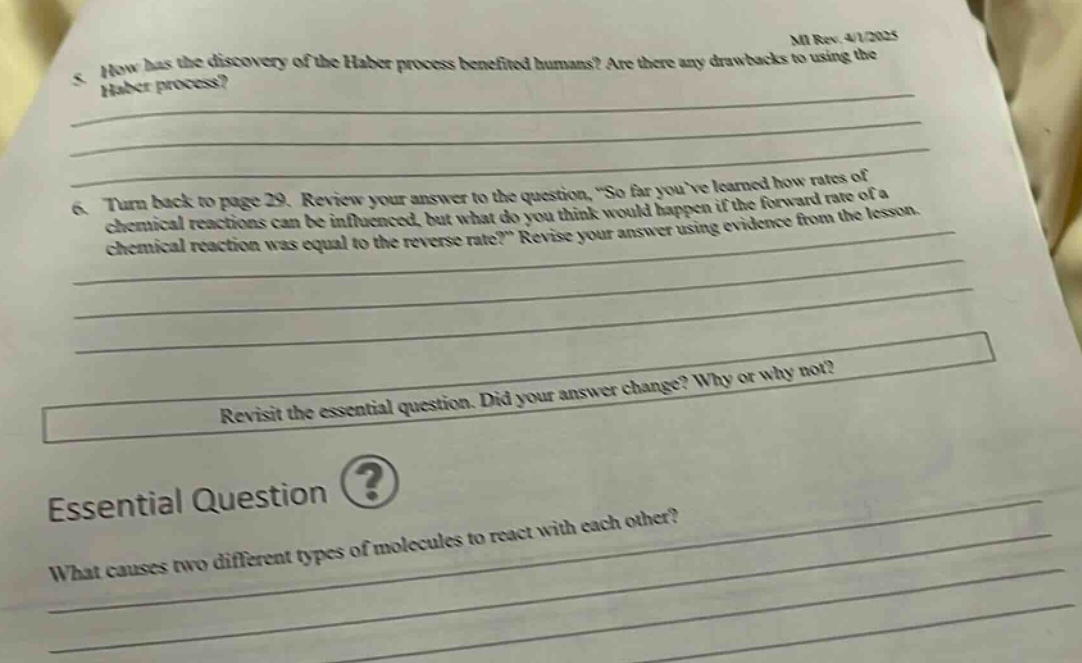
5. how has the discovery of the haber process benefited humans? are there any drawbacks to using the haber process?\n6. turn back to page 29. review your answer to the question, “so far you’ve learned how rates of chemical reactions can be influenced, but what do you think would happen if the forward rate of a chemical reaction was equal to the reverse rate?” revise your answer using evidence from the lesson.\nrevisit the essential question. did your answer change? why or why not?\nessential question\nwhat causes two different types of molecules to react with each other?
Answer
Brief Explanations:
- Benefits of the Haber - process: The Haber - process is used to produce ammonia ($NH_3$) from nitrogen ($N_2$) and hydrogen ($H_2$). It has greatly increased global food production as ammonia is a key component in fertilizers. This has helped feed a growing population.
- Drawbacks of the Haber - process: It is energy - intensive, consuming a large amount of fossil fuels which contributes to greenhouse gas emissions. Also, over - use of nitrogenous fertilizers can lead to environmental problems like eutrophication in water bodies.
- When forward and reverse reaction rates are equal: A chemical reaction has reached equilibrium. At equilibrium, the concentrations of reactants and products remain constant over time, although the forward and reverse reactions are still occurring.
- What causes two different types of molecules to react: Molecules react when they collide with sufficient energy (activation energy) and with the proper orientation. This is based on the collision theory of chemical reactions.
Answer:
- Benefits: Increased food production via fertilizer production. Drawbacks: High energy consumption and environmental issues.
- When forward and reverse rates are equal, the reaction is at equilibrium with constant reactant and product concentrations.
- Molecules react when they collide with enough energy and proper orientation.