draw lewis dot structures to show how the two given elements form ionic compounds. write the chemical…
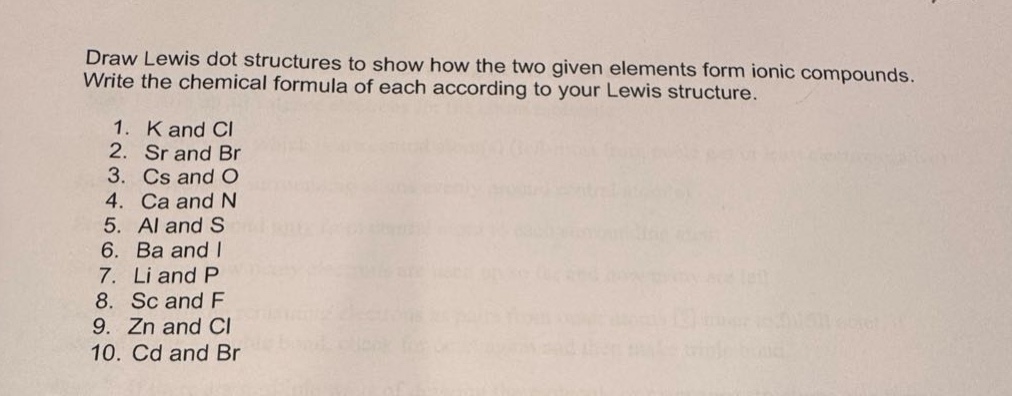
draw lewis dot structures to show how the two given elements form ionic compounds. write the chemical formula of each according to your lewis structure. 1. k and cl 2. sr and br 3. cs and o 4. ca and n 5. al and s 6. ba and i 7. li and p 8. sc and f 9. zn and cl 10. cd and br
Answer
Explanation:
Step1: Determine valence electrons
For K (potassium), it has 1 valence - electron; Cl (chlorine) has 7 valence - electrons. K loses 1 electron to form $K^+$ and Cl gains 1 electron to form $Cl^-$. The chemical formula is KCl. The Lewis dot structure: K: $\cdot$ becomes $K^+$; Cl with 7 dots around it becomes $[:\ddot{Cl}:]^-$.
Step2: For Sr and Br
Sr (strontium) has 2 valence - electrons; Br (bromine) has 7 valence - electrons. Sr loses 2 electrons to form $Sr^{2 + }$ and each Br gains 1 electron. Two Br atoms are needed, and the chemical formula is $SrBr_2$. The Lewis dot structure: Sr with 2 dots around it becomes $Sr^{2+}$; each Br with 7 dots around it becomes $[:\ddot{Br}:]^-$.
Step3: For Cs and O
Cs (cesium) has 1 valence - electron; O (oxygen) has 6 valence - electrons. Two Cs atoms are needed to provide 2 electrons for O. Cs forms $Cs^+$ and O forms $O^{2 - }$. The chemical formula is $Cs_2O$. The Lewis dot structure: Cs: $\cdot$ becomes $Cs^+$; O with 6 dots around it becomes $[:\ddot{O}:]^{2 - }$.
Step4: For Ca and N
Ca (calcium) has 2 valence - electrons; N (nitrogen) has 5 valence - electrons. Three Ca atoms are needed to provide 6 electrons for two N atoms. Ca forms $Ca^{2+}$ and N forms $N^{3 - }$. The chemical formula is $Ca_3N_2$. The Lewis dot structure: Ca with 2 dots around it becomes $Ca^{2+}$; N with 5 dots around it becomes $[:\dot{N}:]^{3 - }$.
Step5: For Al and S
Al (aluminum) has 3 valence - electrons; S (sulfur) has 6 valence - electrons. Two Al atoms are needed to provide 6 electrons for three S atoms. Al forms $Al^{3+}$ and S forms $S^{2 - }$. The chemical formula is $Al_2S_3$. The Lewis dot structure: Al with 3 dots around it becomes $Al^{3+}$; S with 6 dots around it becomes $[:\ddot{S}:]^{2 - }$.
Step6: For Ba and I
Ba (barium) has 2 valence - electrons; I (iodine) has 7 valence - electrons. Ba loses 2 electrons to form $Ba^{2+}$ and two I atoms are needed to gain these electrons. Each I forms $I^-$. The chemical formula is $BaI_2$. The Lewis dot structure: Ba with 2 dots around it becomes $Ba^{2+}$; I with 7 dots around it becomes $[:\ddot{I}:]^-$.
Step7: For Li and P
Li (lithium) has 1 valence - electron; P (phosphorus) has 5 valence - electrons. Three Li atoms are needed to provide 3 electrons for P. Li forms $Li^+$ and P forms $P^{3 - }$. The chemical formula is $Li_3P$. The Lewis dot structure: Li: $\cdot$ becomes $Li^+$; P with 5 dots around it becomes $[:\dot{P}:]^{3 - }$.
Step8: For Sc and F
Sc (scandium) has 3 valence - electrons; F (fluorine) has 7 valence - electrons. Sc loses 3 electrons to form $Sc^{3+}$ and three F atoms are needed to gain these electrons. Each F forms $F^-$. The chemical formula is $ScF_3$. The Lewis dot structure: Sc with 3 dots around it becomes $Sc^{3+}$; F with 7 dots around it becomes $[:\ddot{F}:]^-$.
Step9: For Zn and Cl
Zn (zinc) has 2 valence - electrons; Cl (chlorine) has 7 valence - electrons. Zn loses 2 electrons to form $Zn^{2+}$ and two Cl atoms are needed to gain these electrons. Each Cl forms $Cl^-$. The chemical formula is $ZnCl_2$. The Lewis dot structure: Zn with 2 dots around it becomes $Zn^{2+}$; Cl with 7 dots around it becomes $[:\ddot{Cl}:]^-$.
Step10: For Cd and Br
Cd (cadmium) has 2 valence - electrons; Br (bromine) has 7 valence - electrons. Cd loses 2 electrons to form $Cd^{2+}$ and two Br atoms are needed to gain these electrons. Each Br forms $Br^-$. The chemical formula is $CdBr_2$. The Lewis dot structure: Cd with 2 dots around it becomes $Cd^{2+}$; Br with 7 dots around it becomes $[:\ddot{Br}:]^-$.
Answer:
- Chemical formula: KCl; Lewis dot structure: $K^+$ and $[:\ddot{Cl}:]^-$
- Chemical formula: $SrBr_2$; Lewis dot structure: $Sr^{2+}$ and two $[:\ddot{Br}:]^-$
- Chemical formula: $Cs_2O$; Lewis dot structure: two $Cs^+$ and $[:\ddot{O}:]^{2 - }$
- Chemical formula: $Ca_3N_2$; Lewis dot structure: three $Ca^{2+}$ and two $[:\dot{N}:]^{3 - }$
- Chemical formula: $Al_2S_3$; Lewis dot structure: two $Al^{3+}$ and three $[:\ddot{S}:]^{2 - }$
- Chemical formula: $BaI_2$; Lewis dot structure: $Ba^{2+}$ and two $[:\ddot{I}:]^-$
- Chemical formula: $Li_3P$; Lewis dot structure: three $Li^+$ and $[:\dot{P}:]^{3 - }$
- Chemical formula: $ScF_3$; Lewis dot structure: $Sc^{3+}$ and three $[:\ddot{F}:]^-$
- Chemical formula: $ZnCl_2$; Lewis dot structure: $Zn^{2+}$ and two $[:\ddot{Cl}:]^-$
- Chemical formula: $CdBr_2$; Lewis dot structure: $Cd^{2+}$ and two $[:\ddot{Br}:]^-$