drawing covalent bonds\nthe following structures will have single bonds, draw the structures.\n11. carbon…
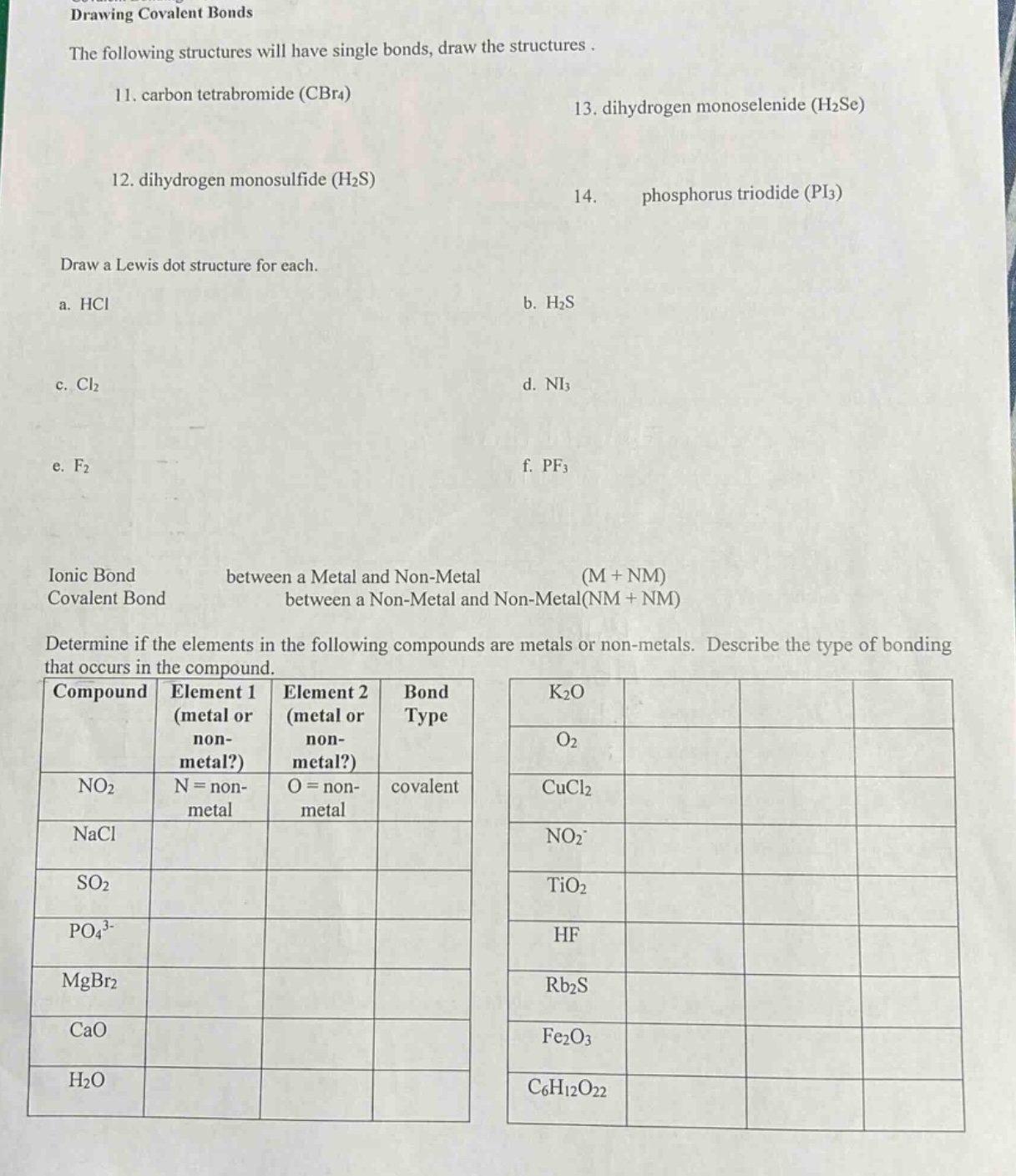
drawing covalent bonds\nthe following structures will have single bonds, draw the structures.\n11. carbon tetrabromide (cbr4)\n12. dihydrogen monosulfide (h2s)\n13. dihydrogen monoselenide (h2se)\n14. phosphorus triodide (pi3)\ndraw a lewis dot structure for each.\na. hcl\nb. h2s\nc. cl2\nd. ni3\ne. f2\nf. pf3\nionic bond between a metal and non - metal (m + nm)\ncovalent bond between a non - metal and non - metal(nm + nm)\ndetermine if the elements in the following compounds are metals or non - metals. describe the type of bonding that occurs in the compound.\n| compound | element 1 (metal or non - metal?) | element 2 (metal or non - metal?) | bond type |\n| ---- | ---- | ---- | ---- |\n| no2 | n = non - metal | o = non - metal | covalent |\n| nacl | | | |\n| so2 | | | |\n| po4^3 - | | | |\n| mgbr2 | | | |\n| cao | | | |\n| h2o | | | |\n| k2o | | | |\n| o2 | | | |\n| cucl2 | | | |\n| no2^- | | | |\n| tio2 | | | |\n| hf | | | |\n| rb2s | | | |\n| fe2o3 | | | |\n| c6h12o22 | | | |
Answer
Explanation:
Step1: Recall element types
Metals are on the left - side and middle of the periodic table, non - metals on the right.
Step2: Determine bond type for $K_2O$
$K$ is a metal, $O$ is a non - metal. So the bond is ionic.
Step3: Determine bond type for $O_2$
$O$ is a non - metal. Two non - metals form a covalent bond.
Step4: Determine bond type for $CuCl_2$
$Cu$ is a metal, $Cl$ is a non - metal. So the bond is ionic.
Step5: Determine bond type for $NO_2^-$
$N$ and $O$ are non - metals. So the bond is covalent.
Step6: Determine bond type for $TiO_2$
$Ti$ is a metal, $O$ is a non - metal. So the bond is ionic.
Step7: Determine bond type for $HF$
$H$ and $F$ are non - metals. So the bond is covalent.
Step8: Determine bond type for $Rb_2S$
$Rb$ is a metal, $S$ is a non - metal. So the bond is ionic.
Step9: Determine bond type for $Fe_2O_3$
$Fe$ is a metal, $O$ is a non - metal. So the bond is ionic.
Step10: Determine bond type for $C_6H_{12}O_{22}$
$C$, $H$, and $O$ are non - metals. So the bond is covalent.
| Compound | Element 1 (metal or non - metal?) | Element 2 (metal or non - metal?) | Bond Type |
|---|---|---|---|
| $K_2O$ | $K$ = metal | $O$ = non - metal | ionic |
| $O_2$ | $O$ = non - metal | $O$ = non - metal | covalent |
| $CuCl_2$ | $Cu$ = metal | $Cl$ = non - metal | ionic |
| $NO_2^-$ | $N$ = non - metal | $O$ = non - metal | covalent |
| $TiO_2$ | $Ti$ = metal | $O$ = non - metal | ionic |
| $HF$ | $H$ = non - metal | $F$ = non - metal | covalent |
| $Rb_2S$ | $Rb$ = metal | $S$ = non - metal | ionic |
| $Fe_2O_3$ | $Fe$ = metal | $O$ = non - metal | ionic |
| $C_6H_{12}O_{22}$ | $C$ = non - metal, $H$ = non - metal, $O$ = non - metal | - | covalent |
For Lewis dot structures:
a. $HCl$
Explanation:
Step1: Count valence electrons
$H$ has 1 valence electron, $Cl$ has 7. Total = 8.
Step2: Arrange atoms
$H$ is less electronegative, so $H$ is central (in this case, $H$ is bonded to $Cl$).
Step3: Distribute electrons
Draw a single bond between $H$ and $Cl$, and place 3 lone - pairs on $Cl$. The Lewis dot structure is $H:Cl:$ with 3 lone - pairs on $Cl$.
b. $H_2S$
Explanation:
Step1: Count valence electrons
$H$ has 1 valence electron each, $S$ has 6. Total = 8.
Step2: Arrange atoms
$S$ is the central atom, with 2 $H$ atoms bonded to it.
Step3: Distribute electrons
Draw single bonds between $S$ and each $H$. Then place 2 lone - pairs on $S$. The Lewis dot structure is $H:S:H$ with 2 lone - pairs on $S$.
c. $Cl_2$
Explanation:
Step1: Count valence electrons
Each $Cl$ has 7 valence electrons. Total = 14.
Step2: Arrange atoms
Two $Cl$ atoms are bonded to each other.
Step3: Distribute electrons
Draw a single bond between the two $Cl$ atoms and place 3 lone - pairs on each $Cl$ atom. The Lewis dot structure is $Cl:Cl:$ with 3 lone - pairs on each $Cl$.
d. $NI_3$
Explanation:
Step1: Count valence electrons
$N$ has 5 valence electrons, each $I$ has 7. Total = 5 + 3×7=26.
Step2: Arrange atoms
$N$ is the central atom, with 3 $I$ atoms bonded to it.
Step3: Distribute electrons
Draw single bonds between $N$ and each $I$. Then place 3 lone - pairs on each $I$ and 1 lone - pair on $N$. The Lewis dot structure is $I:N:I$ with 3 lone - pairs on each $I$ and 1 lone - pair on $N$.
e. $F_2$
Explanation:
Step1: Count valence electrons
Each $F$ has 7 valence electrons. Total = 14.
Step2: Arrange atoms
Two $F$ atoms are bonded to each other.
Step3: Distribute electrons
Draw a single bond between the two $F$ atoms and place 3 lone - pairs on each $F$ atom. The Lewis dot structure is $F:F:$ with 3 lone - pairs on each $F$.
f. $PF_3$
Explanation:
Step1: Count valence electrons
$P$ has 5 valence electrons, each $F$ has 7. Total = 5+3×7 = 26.
Step2: Arrange atoms
$P$ is the central atom, with 3 $F$ atoms bonded to it.
Step3: Distribute electrons
Draw single bonds between $P$ and each $F$. Then place 3 lone - pairs on each $F$ and 1 lone - pair on $P$. The Lewis dot structure is $F:P:F$ with 3 lone - pairs on each $F$ and 1 lone - pair on $P$.
For drawing single - bond structures:
11. $CBr_4$
Explanation:
Step1: Count valence electrons
$C$ has 4 valence electrons, each $Br$ has 7. Total = 4 + 4×7=32.
Step2: Arrange atoms
$C$ is the central atom, with 4 $Br$ atoms bonded to it.
Step3: Draw structure
Draw single bonds between $C$ and each $Br$. The structure is a tetrahedral - like shape with $C$ in the center and $Br$ atoms at the vertices.
12. $H_2S$
Explanation:
Step1: Count valence electrons
$H$ has 1 valence electron each, $S$ has 6. Total = 8.
Step2: Arrange atoms
$S$ is the central atom, with 2 $H$ atoms bonded to it.
Step3: Draw structure
Draw single bonds between $S$ and each $H$. The structure is a bent shape with $S$ in the center and $H$ atoms on either side.
13. $H_2Se$
Explanation:
Step1: Count valence electrons
$H$ has 1 valence electron each, $Se$ has 6. Total = 8.
Step2: Arrange atoms
$Se$ is the central atom, with 2 $H$ atoms bonded to it.
Step3: Draw structure
Draw single bonds between $Se$ and each $H$. The structure is a bent shape with $Se$ in the center and $H$ atoms on either side.
14. $PI_3$
Explanation:
Step1: Count valence electrons
$P$ has 5 valence electrons, each $I$ has 7. Total = 5+3×7 = 26.
Step2: Arrange atoms
$P$ is the central atom, with 3 $I$ atoms bonded to it.
Step3: Draw structure
Draw single bonds between $P$ and each $I$. The structure is a trigonal - pyramidal shape with $P$ in the center and $I$ atoms at the vertices.