1. in the element krypton, how do we calculate the number of: a. protons b. neutrons c. electrons 2. in the…
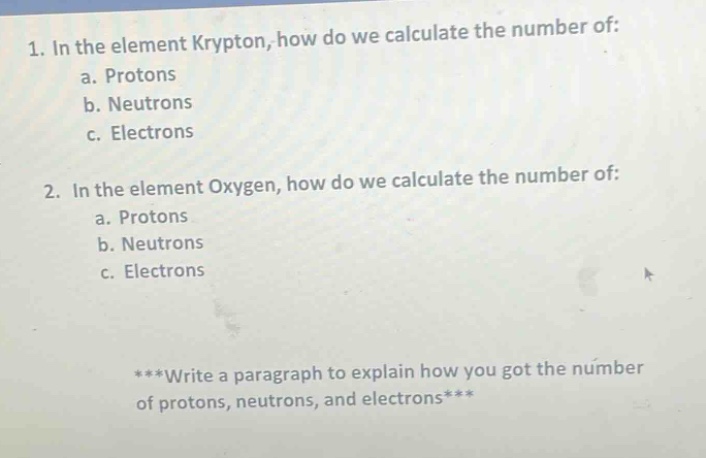
1. in the element krypton, how do we calculate the number of: a. protons b. neutrons c. electrons 2. in the element oxygen, how do we calculate the number of: a. protons b. neutrons c. electrons ***write a paragraph to explain how you got the number of protons, neutrons, and electrons***
Answer
Explanation:
Step1: Determine protons
The number of protons is equal to the atomic number. For Krypton (Kr), atomic number is 36, so number of protons = 36. For Oxygen (O), atomic number is 8, so number of protons = 8.
Step2: Determine neutrons
The number of neutrons = mass - number - atomic - number. Krypton has an average atomic mass of about 83.80. So number of neutrons for Kr is approximately 84 - 36=48. Oxygen has an average atomic mass of about 16.00. So number of neutrons for O is 16 - 8 = 8.
Step3: Determine electrons
In a neutral atom, the number of electrons is equal to the number of protons. So for Krypton, number of electrons = 36. For Oxygen, number of electrons = 8.
Answer:
a. Krypton: 36 b. Krypton: approximately 48 c. Krypton: 36 2. a. Oxygen: 8 b. Oxygen: 8 c. Oxygen: 8
The number of protons is determined by the atomic - number of the element, which is unique to each element. The number of neutrons is calculated by subtracting the atomic number from the mass number (average atomic mass rounded to the nearest whole number for simplicity in non - isotope specific cases). In a neutral atom, the number of electrons is equal to the number of protons to maintain electrical neutrality.