5. epsom salt mgso₄ (we already wrote o, above, so will leave it out here)\n|element|chemical…
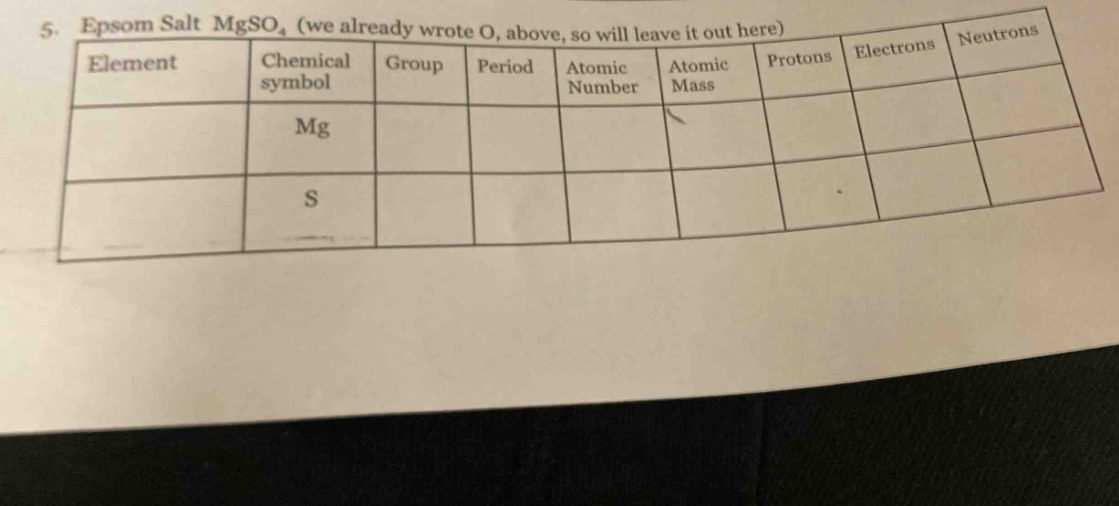
5. epsom salt mgso₄ (we already wrote o, above, so will leave it out here)\n|element|chemical symbol|group|period|atomic number|atomic mass|protons|electrons|neutrons|\n|----|----|----|----|----|----|----|----|----|\n| |mg| | | | | | | |\n| |s| | | | | | | |
Answer
Explanation:
Step1: Recall element properties
For magnesium (Mg):
- Group: 2
- Period: 3
- Atomic number ($Z$) = 12. Since atomic number = number of protons = number of electrons in a neutral atom, number of protons = 12, number of electrons = 12.
- Atomic mass ($A$) ≈ 24.31. Number of neutrons = $A - Z$, so number of neutrons ≈ 24.31 - 12 ≈ 12.31, usually rounded to 12 for the most common isotope.
Step2: Recall sulfur (S) properties
- Group: 16
- Period: 3
- Atomic number ($Z$) = 16. So number of protons = 16, number of electrons = 16 in a neutral atom.
- Atomic mass ($A$) ≈ 32.07. Number of neutrons = $A - Z$, so number of neutrons ≈ 32.07 - 16 ≈ 16.07, usually rounded to 16 for the most common isotope.
| Element | Chemical symbol | Group | Period | Atomic Number | Atomic Mass | Protons | Electrons | Neutrons |
|---|---|---|---|---|---|---|---|---|
| Magnesium | Mg | 2 | 3 | 12 | 24.31 | 12 | 12 | 12 |
| Sulfur | S | 16 | 3 | 16 | 32.07 | 16 | 16 | 16 |
Answer:
| Element | Chemical symbol | Group | Period | Atomic Number | Atomic Mass | Protons | Electrons | Neutrons |
|---|---|---|---|---|---|---|---|---|
| Magnesium | Mg | 2 | 3 | 12 | 24.31 | 12 | 12 | 12 |
| Sulfur | S | 16 | 3 | 16 | 32.07 | 16 | 16 | 16 |