in the equation c₃h₈ + 5o₂ → 3co₂ + 4h₂o, how many moles of oxygen are required to react completely with 2…
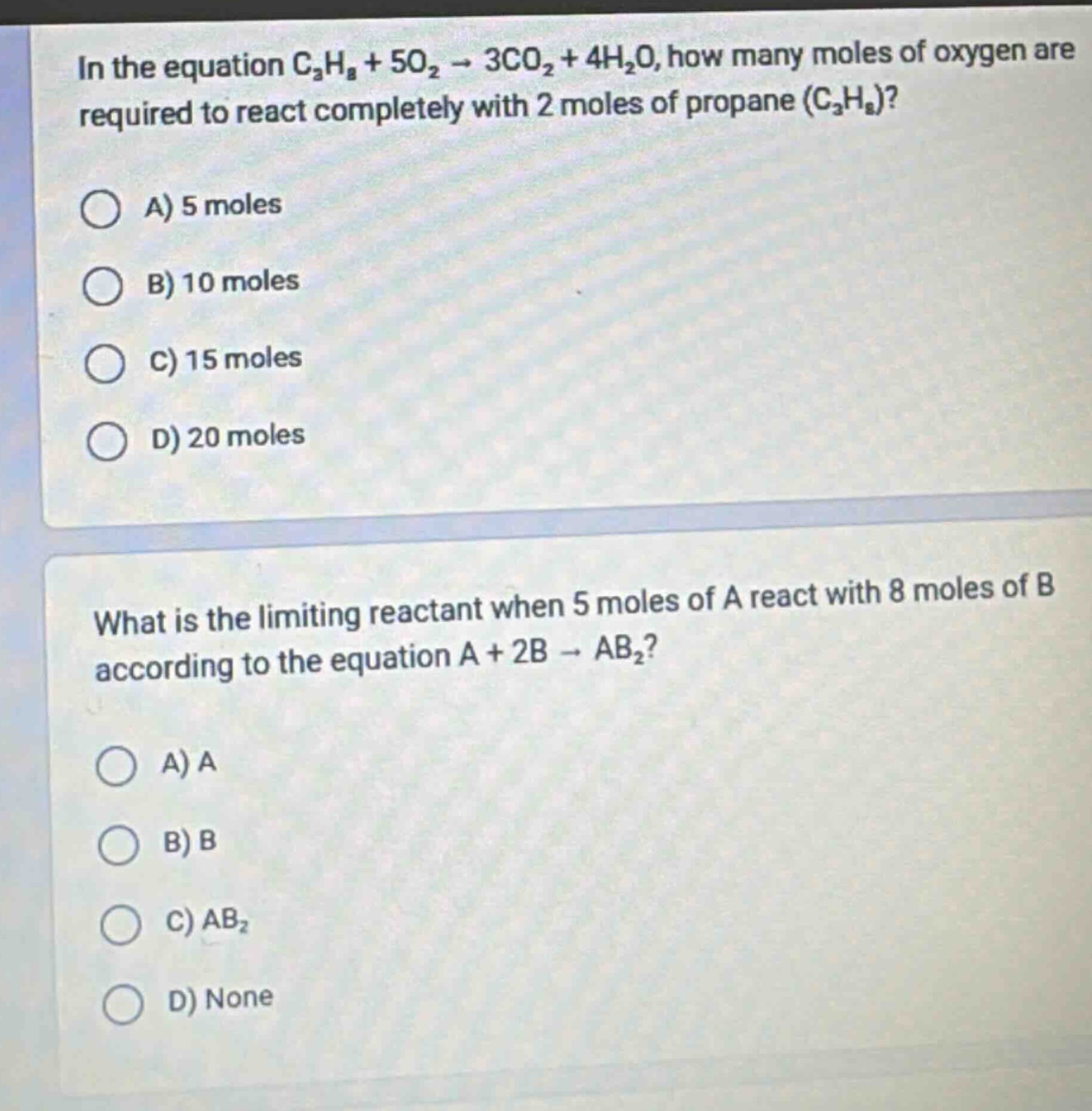
in the equation c₃h₈ + 5o₂ → 3co₂ + 4h₂o, how many moles of oxygen are required to react completely with 2 moles of propane (c₃h₈)?\na) 5 moles\nb) 10 moles\nc) 15 moles\nd) 20 moles\nwhat is the limiting reactant when 5 moles of a react with 8 moles of b according to the equation a + 2b → ab₂?\na) a\nb) b\nc) ab₂\nd) none
Answer
Explanation:
Step1: Determine mole - ratio from the equation
From the equation $C_3H_8 + 5O_2\rightarrow3CO_2 + 4H_2O$, the mole - ratio of $C_3H_8$ to $O_2$ is $1:5$.
Step2: Calculate moles of $O_2$ for 2 moles of $C_3H_8$
If 1 mole of $C_3H_8$ reacts with 5 moles of $O_2$, then for 2 moles of $C_3H_8$, the moles of $O_2$ required is $2\times5 = 10$ moles.
Step3: Analyze the second reaction for limiting reactant
From the equation $A + 2B\rightarrow AB_2$, the mole - ratio of $A$ to $B$ is $1:2$. If 5 moles of $A$ react, the moles of $B$ required is $5\times2=10$ moles. But we have only 8 moles of $B$. So, $B$ is the limiting reactant.
Answer:
- B) 10 moles
- B) B