which equation obeys the law of conservation of mass?\n○ h₂(g) + o₂(g) → h₂o(g)\n○ h₂(g) + o₂(g) → h₂o(g)…
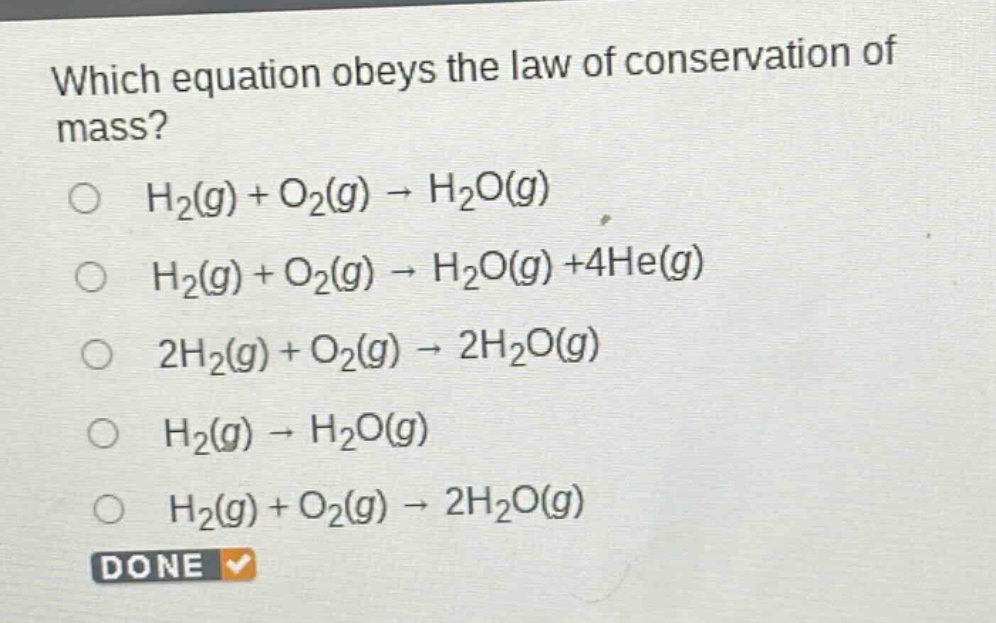
which equation obeys the law of conservation of mass?\n○ h₂(g) + o₂(g) → h₂o(g)\n○ h₂(g) + o₂(g) → h₂o(g) +4he(g)\n○ 2h₂(g) + o₂(g) → 2h₂o(g)\n○ h₂(g) → h₂o(g)\n○ h₂(g) + o₂(g) → 2h₂o(g)\ndone
Answer
Explanation:
Step1: Recall law of conservation of mass
The law states that the total mass of reactants equals the total mass of products, and the number of atoms of each element must be the same on both sides of a chemical equation.
Step2: Analyze first option
In $H_2(g)+O_2(g)\rightarrow H_2O(g)$, on the left - hand side, there are 2 oxygen atoms from $O_2$ but only 1 oxygen atom in $H_2O$ on the right - hand side. So, it does not obey the law.
Step3: Analyze second option
In $H_2(g)+O_2(g)\rightarrow H_2O(g) + 4He(g)$, helium ($He$) atoms appear on the product side but not on the reactant side. So, it does not obey the law.
Step4: Analyze third option
In $2H_2(g)+O_2(g)\rightarrow 2H_2O(g)$, on the left - hand side, there are 4 hydrogen atoms ($2\times2$ from $2H_2$) and 2 oxygen atoms from $O_2$. On the right - hand side, in $2H_2O$, there are also 4 hydrogen atoms ($2\times2$) and 2 oxygen atoms ($2\times1$). It obeys the law of conservation of mass.
Step5: Analyze fourth option
In $H_2(g)\rightarrow H_2O(g)$, oxygen atoms appear on the product side but not on the reactant side. So, it does not obey the law.
Step6: Analyze fifth option
In $H_2(g)+O_2(g)\rightarrow 2H_2O(g)$, on the left - hand side, there are 2 hydrogen atoms from $H_2$ and 2 oxygen atoms from $O_2$. On the right - hand side, in $2H_2O$, there are 4 hydrogen atoms ($2\times2$) and 2 oxygen atoms ($2\times1$). The number of hydrogen atoms is not balanced. So, it does not obey the law.
Answer:
$2H_2(g)+O_2(g)\rightarrow 2H_2O(g)$