the equation for the ph of a substance is ph = -logh+, where h+ is the concentration of hydrogen ions. a…
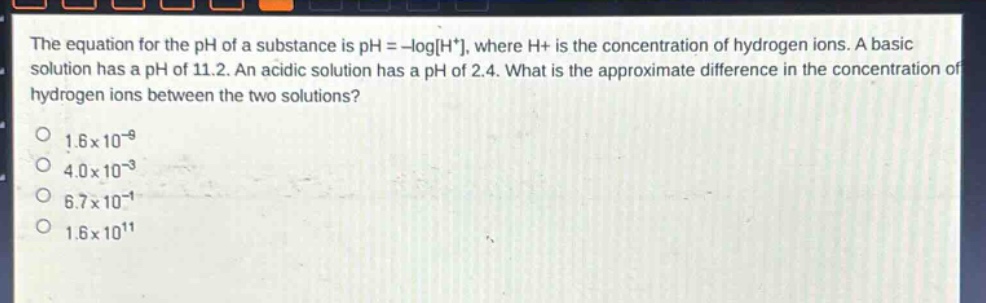
the equation for the ph of a substance is ph = -logh+, where h+ is the concentration of hydrogen ions. a basic solution has a ph of 11.2. an acidic solution has a ph of 2.4. what is the approximate difference in the concentration of hydrogen ions between the two solutions?\n1.6x10^(-9)\n4.0x10^(-3)\n6.7x10^(-1)\n1.6x10^(11)
Answer
Explanation:
Step1: Find $[H^+]$ for basic solution
Given $pH = -\log[H^+]$, for basic solution with $pH = 11.2$, we can rewrite the formula as $[H^+]{basic}=10^{-pH}$. So $[H^+]{basic}=10^{- 11.2}$.
Step2: Find $[H^+]$ for acidic solution
For acidic solution with $pH = 2.4$, using $[H^+]=10^{-pH}$, we get $[H^+]_{acidic}=10^{-2.4}$.
Step3: Calculate the difference
The difference $\Delta[H^+]=[H^+]{acidic}-[H^+]{basic}=10^{-2.4}-10^{-11.2}$. Since $10^{-11.2}$ is extremely small compared to $10^{-2.4}$, we can approximate $\Delta[H^+]\approx10^{-2.4}$. $10^{-2.4}=\frac{1}{10^{2.4}}\approx\frac{1}{251.19}\approx4.0\times 10^{-3}$.
Answer:
$4.0\times 10^{-3}$