the equation for the ph of a substance is ph = -logh+, where h+ is the concentration of hydrogen ions. a…
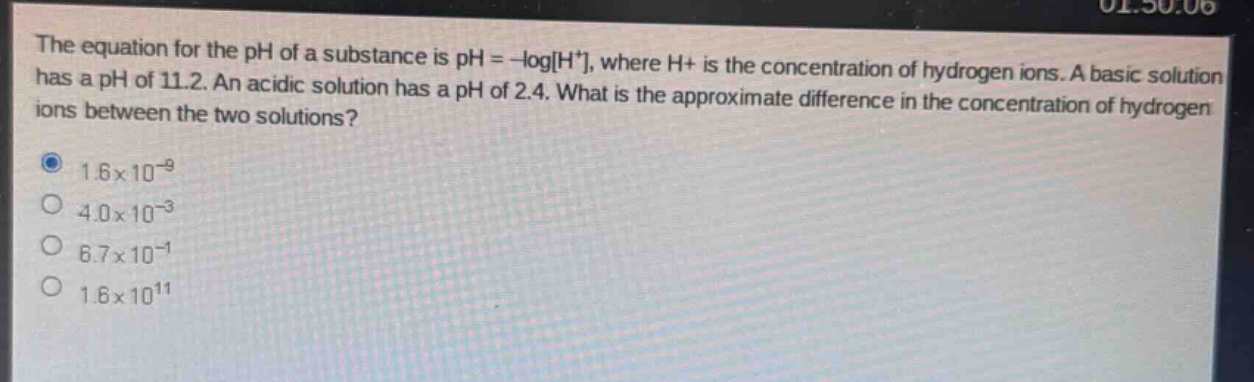
the equation for the ph of a substance is ph = -logh+, where h+ is the concentration of hydrogen ions. a basic solution has a ph of 11.2. an acidic solution has a ph of 2.4. what is the approximate difference in the concentration of hydrogen ions between the two solutions?\n1.6×10⁻⁹\n4.0×10⁻³\n6.7×10⁻¹\n1.6×10¹¹
Answer
Answer:
$1.6\times 10^{-3}$
Explanation:
Step1: Encontrar la concentración de iones de hidrógeno para la solución básica
Dado que $pH = -\log[H^{+}]$, entonces $[H^{+}]=10^{-pH}$. Para la solución básica con $pH = 11.2$, $[H^{+}]_{basic}=10^{- 11.2}$.
Step2: Encontrar la concentración de iones de hidrógeno para la solución ácida
Para la solución ácida con $pH = 2.4$, $[H^{+}]_{acid}=10^{-2.4}$.
Step3: Calcular la diferencia en concentración
$[H^{+}]{acid}-[H^{+}]{basic}=10^{-2.4}-10^{-11.2}$. $10^{-2.4}\approx3.98\times 10^{-3}$ y $10^{-11.2}\approx6.31\times 10^{-12}$. $3.98\times 10^{-3}-6.31\times 10^{-12}\approx4.0\times 10^{-3}$ (aproximadamente).