which equation above represents a precipitation reaction? \n\\( 2h_2(g) + o_2(g) \\rightarrow 2h_2o(l)…
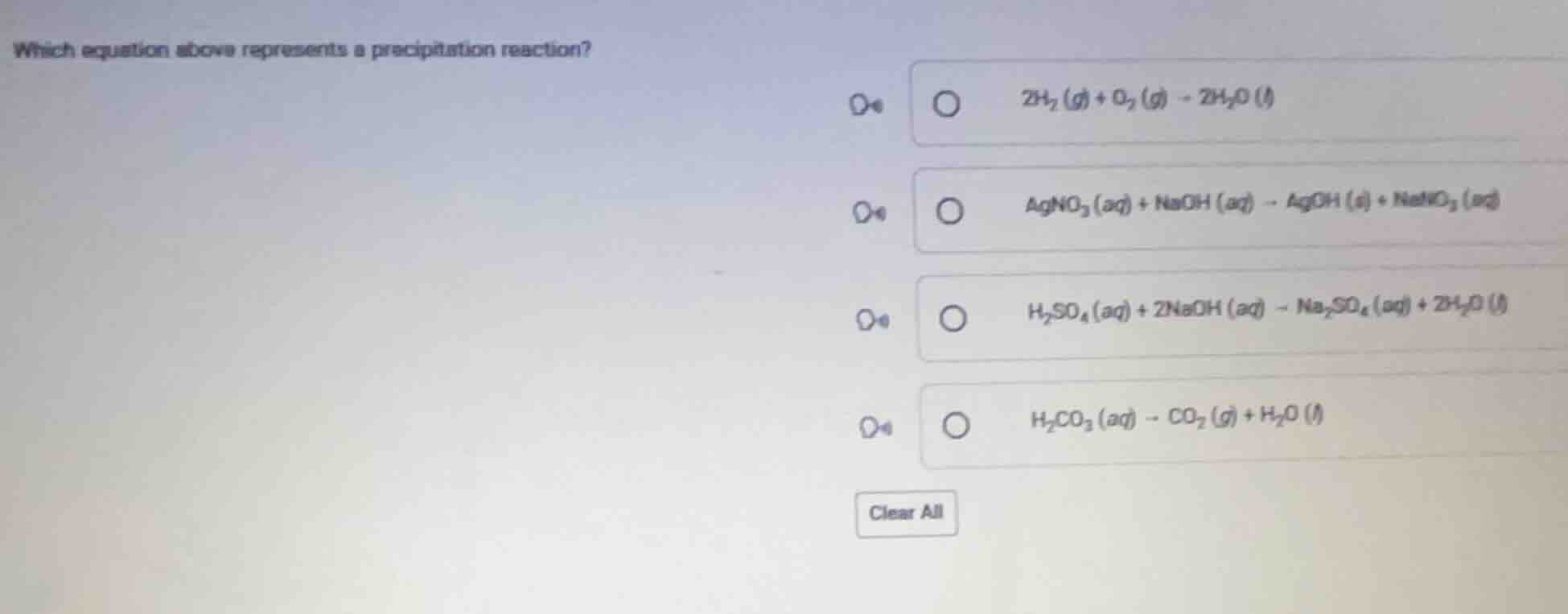
which equation above represents a precipitation reaction? \n\\( 2h_2(g) + o_2(g) \\rightarrow 2h_2o(l) \\)\n\\( agno_3(aq) + naoh(aq) \\rightarrow agoh(s) + nano_3(aq) \\)\n\\( h_2so_4(aq) + 2naoh(aq) \\rightarrow na_2so_4(aq) + 2h_2o(l) \\)\n\\( h_2co_3(aq) \\rightarrow co_2(g) + h_2o(l) \\)
Answer
Answer:
B. $\text{AgNO}_3 \ (aq) + \text{NaOH} \ (aq) \rightarrow \text{AgOH} \ (s) + \text{NaNO}_3 \ (aq)$
Brief Explanations:
A precipitation reaction forms an insoluble solid (precipitate, labeled (s)) from aqueous reactants.
- Option A is a combustion/synthesis reaction forming liquid water.
- Option B produces solid $\text{AgOH}$, a precipitate, fitting the definition.
- Option C is an acid-base neutralization reaction forming water and soluble salt.
- Option D is a decomposition reaction forming gas and liquid.