the equation below shows a reaction that produces calcium carbonate. ca(oh)₂(s) + co₂(g) → caco₃(s) +…
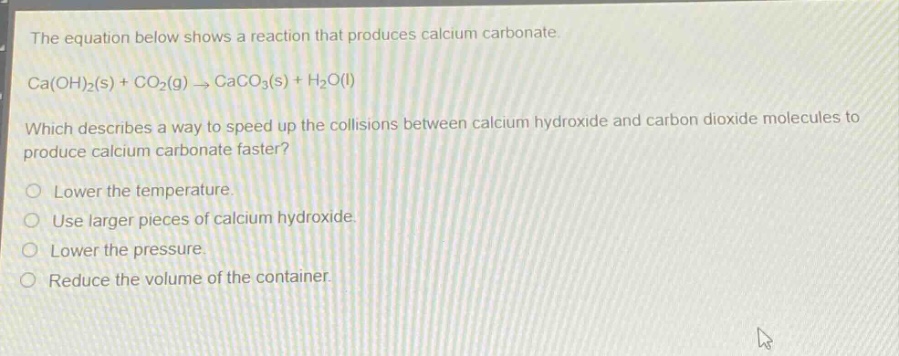
the equation below shows a reaction that produces calcium carbonate. ca(oh)₂(s) + co₂(g) → caco₃(s) + h₂o(l)\nwhich describes a way to speed up the collisions between calcium hydroxide and carbon dioxide molecules to produce calcium carbonate faster?\nlower the temperature.\nuse larger pieces of calcium hydroxide.\nlower the pressure.\nreduce the volume of the container.
Answer
Answer:
D. Reduce the volume of the container.
Explanation:
Step1: Understand reaction - rate factors
Increasing temperature, surface - area, pressure or concentration speeds up reactions.
Step2: Analyze each option
- Lowering temperature slows down molecular motion, reducing collision frequency.
- Using larger pieces of calcium hydroxide decreases surface - area, reducing reaction rate.
- Lowering pressure decreases the number of gas molecules per unit volume, reducing collision frequency.
- Reducing the volume of the container increases the pressure of the gas ($CO_2$), increasing the collision frequency between $Ca(OH)_2$ and $CO_2$ molecules, thus speeding up the reaction.