6. explain what a polyprotic acid is.\n7. analyze why the arrhenius model of acids and bases does not…
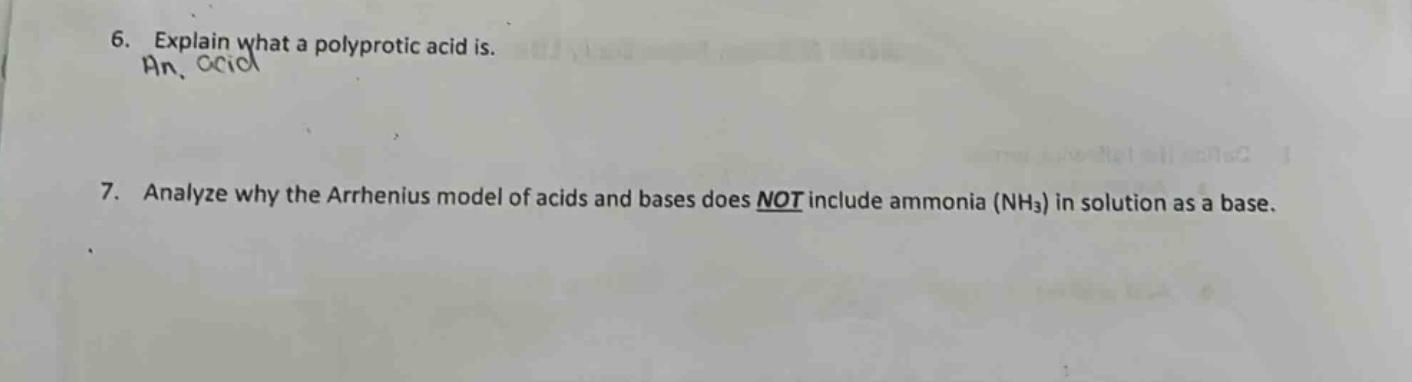
6. explain what a polyprotic acid is.\n7. analyze why the arrhenius model of acids and bases does not include ammonia (nh₃) in solution as a base.
Answer
Brief Explanations:
- A polyprotic acid is an acid that can donate more than one proton (H⁺ ion) per molecule in successive ionization steps. For example, sulfuric acid (H₂SO₄) can first donate one H⁺ to form HSO₄⁻ and then donate another H⁺ to form SO₄²⁻.
- The Arrhenius model defines a base as a substance that dissociates in water to produce hydroxide ions (OH⁻). Ammonia (NH₃) in solution does not dissociate to directly produce OH⁻. Instead, it reacts with water in a reversible reaction: NH₃ + H₂O ⇌ NH₄⁺+ OH⁻. Since it does not dissociate to release OH⁻ in the way the Arrhenius model requires (direct dissociation of the base itself to give OH⁻), ammonia is not included as a base under the Arrhenius model.
Answer:
- An acid that can donate more than one proton per molecule in successive ionization steps.
- Ammonia does not dissociate to directly produce OH⁻ as required by the Arrhenius model; it reacts with water to produce OH⁻.