facts about five elements\nelement atomic mass (amu) total electrons valence electrons year…
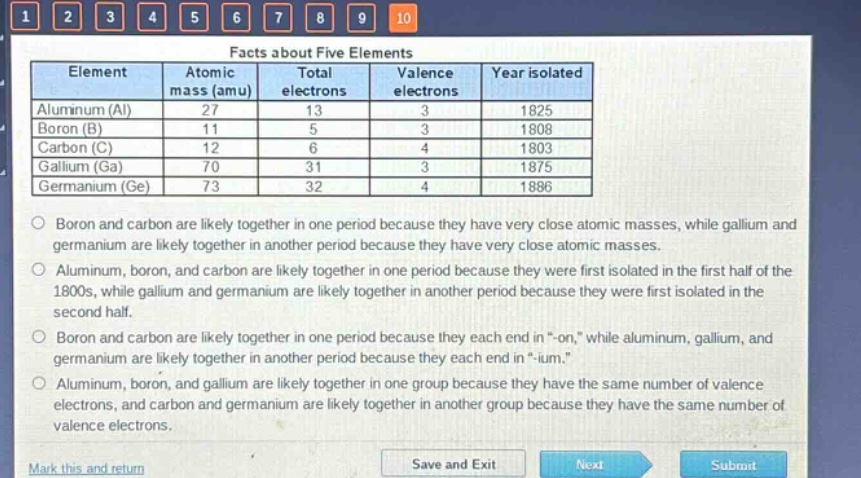
facts about five elements\nelement atomic mass (amu) total electrons valence electrons year isolated\naluminum (al) 27 13 3 1825\nboron (b) 11 5 3 1808\ncarbon (c) 12 6 4 1803\ngallium (ga) 70 31 3 1875\ngermanium (ge) 73 32 4 1886\n\nboron and carbon are likely together in one period because they have very close atomic masses, while gallium and germanium are likely together in another period because they have very close atomic masses.\naluminum, boron, and carbon are likely together in one period because they were first isolated in the first half of the 1800s, while gallium and germanium are likely together in another period because they were first isolated in the second half.\nboron and carbon are likely together in one period because they each end in \-on,\ while aluminum, gallium, and germanium are likely together in another period because they each end in \-ium.\\naluminum, boron, and gallium are likely together in one group because they have the same number of valence electrons, and carbon and germanium are likely together in another group because they have the same number of valence electrons.
Answer
Brief Explanations:
In the periodic table, elements in the same group have the same number of valence electrons. Aluminum, boron, and gallium have 3 valence electrons, and carbon and germanium have 4 valence electrons. Atomic mass and the year of isolation are not the determining factors for grouping elements in the periodic - table, and the ending of element names has no relation to their periodic - table arrangement.
Answer:
Aluminum, boron, and gallium are likely together in one group because they have the same number of valence electrons, and carbon and germanium are likely together in another group because they have the same number of valence electrons.