2. figure 7 shows a flask containing nitrogen and hydrogen. when the temperature of the flask is raised…
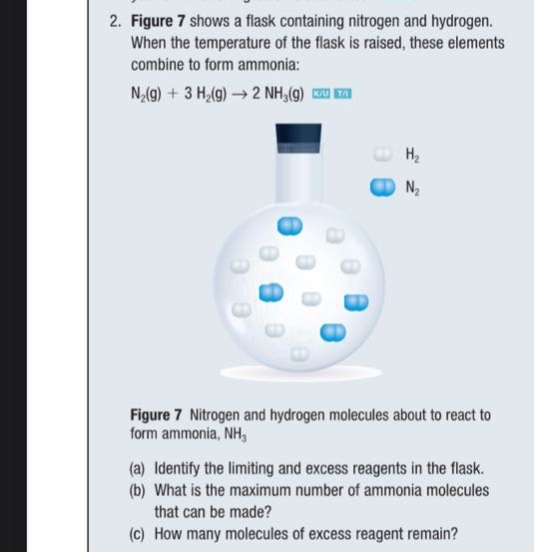
2. figure 7 shows a flask containing nitrogen and hydrogen. when the temperature of the flask is raised, these elements combine to form ammonia: n₂(g) + 3 h₂(g) → 2 nh₃(g) figure 7 nitrogen and hydrogen molecules about to react to form ammonia, nh₃ (a) identify the limiting and excess reagents in the flask. (b) what is the maximum number of ammonia molecules that can be made? (c) how many molecules of excess reagent remain?
Answer
Explanation:
Step1: Count reactant molecules
Count the number of $N_2$ and $H_2$ molecules in the flask. Assume there are 4 $N_2$ molecules and 12 $H_2$ molecules.
Step2: Determine mole - ratio from equation
The balanced chemical equation is $N_2(g)+3H_2(g)\rightarrow 2NH_3(g)$. The mole - ratio of $N_2$ to $H_2$ is 1:3.
Step3: Identify limiting and excess reagents
For 4 $N_2$ molecules, we would need $4\times3 = 12$ $H_2$ molecules. Since we have 12 $H_2$ molecules, neither reagent is in excess. Both $N_2$ and $H_2$ are limiting reagents in this case (as they are present in stoichiometric amounts).
Step4: Calculate maximum number of ammonia molecules
From the equation, 1 $N_2$ molecule produces 2 $NH_3$ molecules. Since we have 4 $N_2$ molecules, the number of $NH_3$ molecules produced is $4\times2=8$ molecules.
Step5: Calculate remaining excess reagent molecules
Since both reagents are completely consumed, the number of excess - reagent molecules remaining is 0.
Answer:
(a) Both $N_2$ and $H_2$ are limiting reagents (present in stoichiometric amounts). (b) 8 ammonia molecules. (c) 0 molecules of excess reagent.