first, lets use what we know about reactions to figure out how chemical engineers change the conditions to…
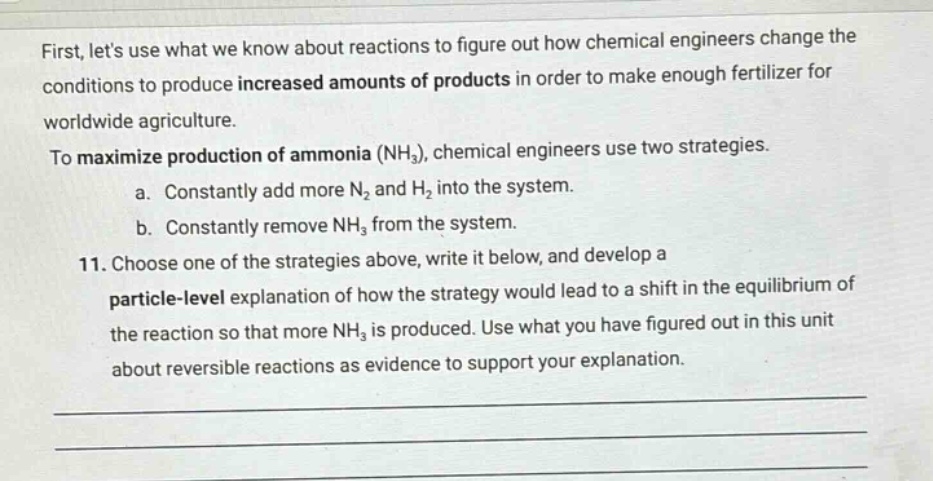
first, lets use what we know about reactions to figure out how chemical engineers change the conditions to produce increased amounts of products in order to make enough fertilizer for worldwide agriculture. to maximize production of ammonia (nh₃), chemical engineers use two strategies. a. constantly add more n₂ and h₂ into the system. b. constantly remove nh₃ from the system. 11. choose one of the strategies above, write it below, and develop a particle - level explanation of how the strategy would lead to a shift in the equilibrium of the reaction so that more nh₃ is produced. use what you have figured out in this unit about reversible reactions as evidence to support your explanation.
Answer
Brief Explanations:
According to Le - Chatelier's principle, in a reversible reaction, when a change is applied to a system at equilibrium, the system will adjust to counteract that change. For the reaction $N_2 + 3H_2\rightleftharpoons2NH_3$, if we choose the strategy of constantly adding more $N_2$ and $H_2$ into the system, the concentration of the reactants increases. The system tries to reduce this increase in reactant concentration. So, the equilibrium shifts to the right - hand side (product side) to consume the added reactants and produce more $NH_3$. If we choose the strategy of constantly removing $NH_3$ from the system, the concentration of the product decreases. The system then tries to increase the concentration of the product. So, the equilibrium shifts to the right - hand side to produce more $NH_3$ to counteract the decrease in its concentration.
Answer:
If we choose "Constantly add more $N_2$ and $H_2$ into the system": Adding more $N_2$ and $H_2$ increases reactant concentration. According to Le - Chatelier's principle, the equilibrium shifts to the right to consume the added reactants and produce more $NH_3$. If we choose "Constantly remove $NH_3$ from the system": Removing $NH_3$ decreases product concentration. According to Le - Chatelier's principle, the equilibrium shifts to the right to produce more $NH_3$ and restore equilibrium.