which of the following compounds are chiral? view available hint(s) ethane 2 - bromo - 2 - chloropropane…
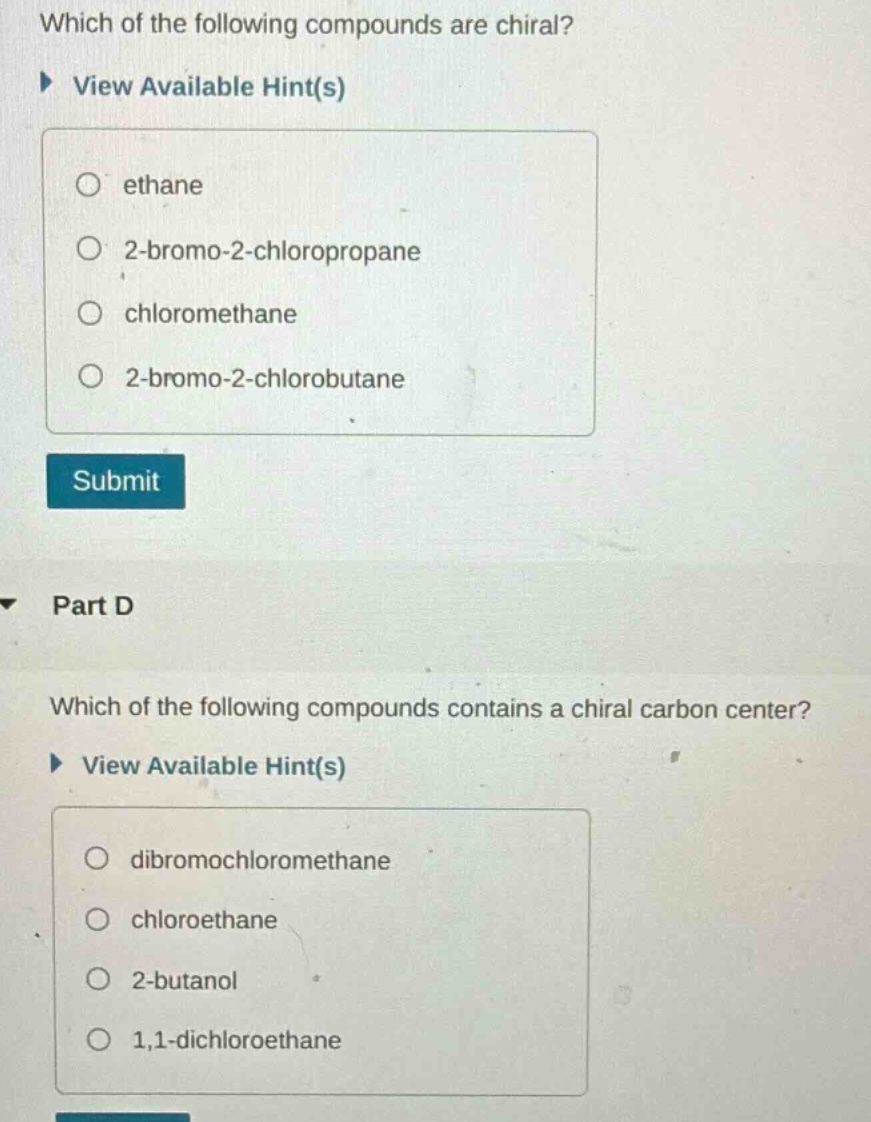
which of the following compounds are chiral? view available hint(s) ethane 2 - bromo - 2 - chloropropane chloromethane 2 - bromo - 2 - chlorobutane submit part d which of the following compounds contains a chiral carbon center? view available hint(s) dibromochloromethane chloroethane 2 - butanol 1,1 - dichloroethane
Answer
Brief Explanations:
A chiral compound has a non - superimposable mirror image. A chiral carbon is a carbon atom bonded to four different groups. For the first question:
- Ethane has no chiral center as all carbon atoms have at least two identical groups.
- 2 - bromo - 2 - chloropropane has a carbon with two identical groups (the two methyl groups attached to the central carbon), so it is not chiral.
- Chloromethane has no chiral center as the carbon is bonded to three hydrogen atoms (identical groups).
- 2 - bromo - 2 - chlorobutane has a chiral carbon (the second carbon is bonded to a bromine, a chlorine, a methyl group and an ethyl group), so it is chiral.
For the second question:
- Dibromochloromethane has no chiral carbon as the carbon is bonded to two bromine atoms (identical groups).
- Chloroethane has no chiral carbon as none of the carbons are bonded to four different groups.
- 2 - butanol has a chiral carbon (the second carbon is bonded to a hydroxyl group, a hydrogen, a methyl group and an ethyl group).
- 1,1 - dichloroethane has no chiral carbon as the first carbon is bonded to two chlorine atoms and the second carbon has three hydrogen atoms.
Answer:
First question: 2 - bromo - 2 - chlorobutane Second question: 2 - butanol