7. which of the following describes waters polarity?\na. both ends of a water molecule have negative…
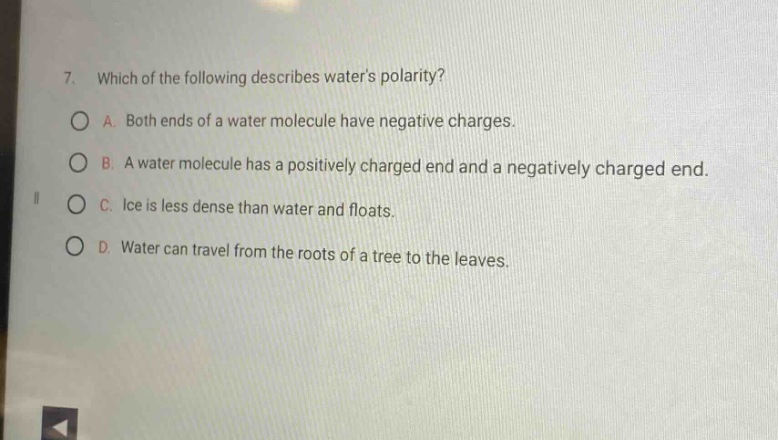
7. which of the following describes waters polarity?\na. both ends of a water molecule have negative charges.\nb. a water molecule has a positively charged end and a negatively charged end.\nc. ice is less dense than water and floats.\nd. water can travel from the roots of a tree to the leaves.
Answer
Brief Explanations:
A polar molecule has a separation of electric charge leading to a positive - charged end and a negative - charged end. Water is a polar molecule due to the unequal sharing of electrons between hydrogen and oxygen, with the oxygen end being more electronegative (negatively charged) and the hydrogen end being relatively positively charged. Option A is incorrect as both ends don't have negative charges. Option C is about density difference between ice and water, not polarity. Option D is about water's capillary action, not polarity.
Answer:
B. A water molecule has a positively charged end and a negatively charged end.