1. from the following enthalpy changes,\ns (s) + ³/₂ o₂ (g) → so₃ (g) δh° = -395.2 kj\n2 so₂ (g) + o₂ (g) →…
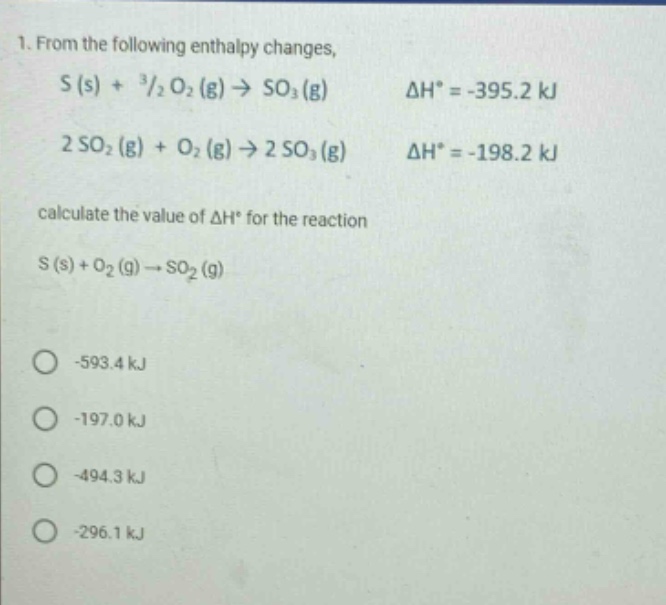
1. from the following enthalpy changes,\ns (s) + ³/₂ o₂ (g) → so₃ (g) δh° = -395.2 kj\n2 so₂ (g) + o₂ (g) → 2 so₃ (g) δh° = -198.2 kj\ncalculate the value of δh° for the reaction\ns (s) + o₂ (g) → so₂ (g)\n-593.4 kj\n-197.0 kj\n-494.3 kj\n-296.1 kj
Answer
Explanation:
Step1: Label the reactions
Let $S(s)+\frac{3}{2}O_2(g)\rightarrow SO_3(g)$ be reaction (1) with $\Delta H_1=- 395.2\ kJ$; $2SO_2(g)+O_2(g)\rightarrow 2SO_3(g)$ be reaction (2) with $\Delta H_2=-198.2\ kJ$; and $S(s)+O_2(g)\rightarrow SO_2(g)$ be reaction (3) with $\Delta H_3$ (which we want to find).
Step2: Manipulate the reactions
We need to manipulate reactions (1) and (2) to get reaction (3). First, reverse reaction (2) and divide it by 2: $SO_3(g)\rightarrow SO_2(g)+\frac{1}{2}O_2(g)$, and its $\Delta H_{2 - new}=\frac{198.2}{2}\ kJ = 99.1\ kJ$.
Step3: Add the reactions
Add reaction (1) and the new - formed reaction: [ \begin{align*} S(s)+\frac{3}{2}O_2(g)&\rightarrow SO_3(g)&\Delta H_1&=-395.2\ kJ\ SO_3(g)&\rightarrow SO_2(g)+\frac{1}{2}O_2(g)&\Delta H_{2 - new}&=99.1\ kJ \end{align*} ] Adding these two reactions gives $S(s)+O_2(g)\rightarrow SO_2(g)$.
Step4: Calculate $\Delta H_3$
According to Hess's law, $\Delta H_3=\Delta H_1+\Delta H_{2 - new}$. [ \begin{align*} \Delta H_3&=-395.2\ kJ + 99.1\ kJ\ &=-296.1\ kJ \end{align*} ]
Answer:
-296.1 kJ