4. which of the following is an example of a strong acid? (a) acetic acid (ch3cooh) (b) hydrochloric acid…
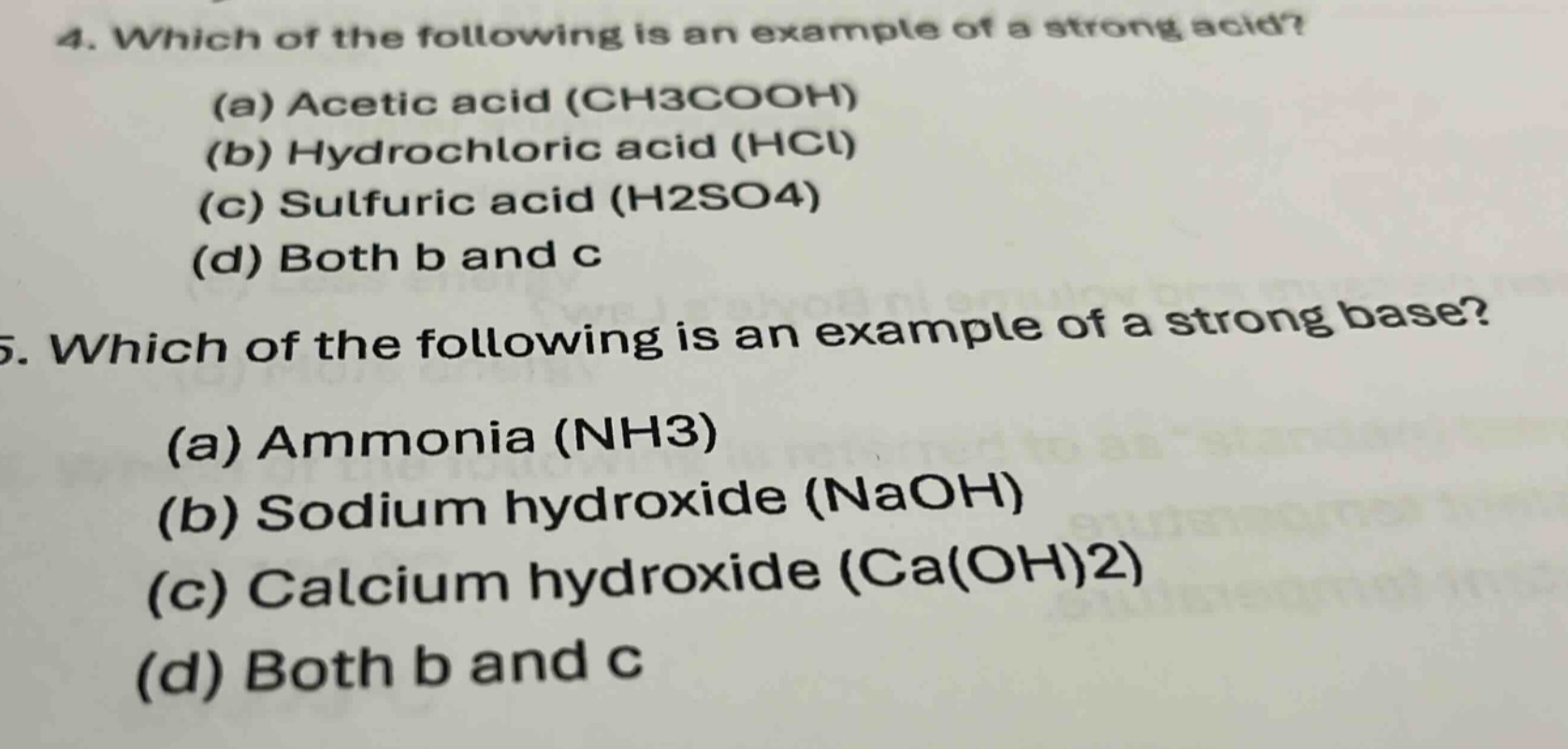
4. which of the following is an example of a strong acid? (a) acetic acid (ch3cooh) (b) hydrochloric acid (hcl) (c) sulfuric acid (h2so4) (d) both b and c 5. which of the following is an example of a strong base? (a) ammonia (nh3) (b) sodium hydroxide (naoh) (c) calcium hydroxide (ca(oh)2) (d) both b and c
Answer
Brief Explanations:
Los ácidos fuertes se disocian completamente en solución acuosa. El ácido clorhídrico (HCl) y el ácido sulfúrico (H₂SO₄) son ejemplos de ácidos fuertes, mientras que el ácido acético (CH₃COOH) es un ácido débil. Las bases fuertes se disocian completamente en solución acuosa. El hidróxido de sodio (NaOH) y el hidróxido de calcio (Ca(OH)₂) son bases fuertes, mientras que la amonía (NH₃) es una base débil.
Answer:
- d) Both b and c
- d) Both b and c