which of the following is an oxidation - reduction reaction?\no fe₂o₃ + 3co → 2fe + 3co₂\no cuso₄ + 2naoh →…
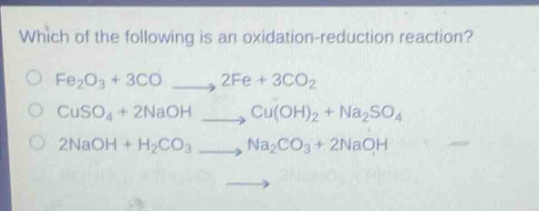
which of the following is an oxidation - reduction reaction?\no fe₂o₃ + 3co → 2fe + 3co₂\no cuso₄ + 2naoh → cu(oh)₂ + na₂so₄\no 2naoh + h₂co₃ → na₂co₃ + 2naoh
Answer
Explanation:
Step1: Recall oxidation - reduction reaction concept
An oxidation - reduction (redox) reaction involves a transfer of electrons, which is reflected by a change in oxidation numbers of elements.
Step2: Analyze the first reaction
In the reaction $\ce{Fe2O3 + 3CO->2Fe + 3CO2}$, for $\ce{Fe}$ in $\ce{Fe2O3}$, its oxidation number is $+ 3$ (since $\ce{O}$ has an oxidation number of $-2$ and in $\ce{Fe2O3}$, $2x+3\times(- 2)=0$, $x = + 3$). In elemental $\ce{Fe}$, its oxidation number is $0$. So $\ce{Fe}$ is reduced. For $\ce{C}$ in $\ce{CO}$, its oxidation number is $+2$ ($x+(-2)=0$, $x = + 2$), and in $\ce{CO2}$, the oxidation number of $\ce{C}$ is $+4$ ($x + 2\times(-2)=0$, $x=+4$). So $\ce{C}$ is oxidized. This is a redox reaction.
Step3: Analyze the second reaction
In the reaction $\ce{CuSO4 + 2NaOH->Cu(OH)2 + Na2SO4}$, this is a double - displacement reaction. The oxidation numbers of $\ce{Cu}$ ($+2$), $\ce{S}$ ($+6$), $\ce{O}$ ($-2$), $\ce{Na}$ ($+1$), and $\ce{H}$ ($+1$) do not change. So it is not a redox reaction.
Step4: Analyze the third reaction
In the reaction $\ce{2NaOH + H2CO3->Na2CO3 + 2H2O}$, this is an acid - base reaction. The oxidation numbers of $\ce{Na}$ ($+1$), $\ce{O}$ ($-2$), $\ce{H}$ ($+1$), and $\ce{C}$ ($+4$) do not change. So it is not a redox reaction.
Answer:
$\ce{Fe2O3 + 3CO->2Fe + 3CO2}$