which of the following is an oxidation - reduction reaction?\no zns(s) + 2o₂(g) → znso₄(s)\no cao(s) +…
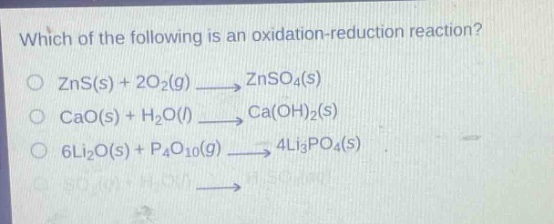
which of the following is an oxidation - reduction reaction?\no zns(s) + 2o₂(g) → znso₄(s)\no cao(s) + h₂o(l) → ca(oh)₂(s)\no 6li₂o(s) + p₄o₁₀(g) → 4li₃po₄(s)
Answer
Explanation:
Step1: Recall oxidation - reduction reaction concept
Oxidation - reduction (redox) reactions involve changes in oxidation states of elements.
Step2: Analyze the first reaction
For $ZnS(s)+2O_2(g)\longrightarrow ZnSO_4(s)$: In $ZnS$, $Zn$ has an oxidation state of + 2 and $S$ has an oxidation state of - 2. In $O_2$, oxygen has an oxidation state of 0. In $ZnSO_4$, $Zn$ is + 2, $S$ is + 6 and $O$ is - 2. Sulfur is oxidized from - 2 to + 6 and oxygen is reduced from 0 to - 2. So it is a redox reaction.
Step3: Analyze the second reaction
For $CaO(s)+H_2O(l)\longrightarrow Ca(OH)_2(s)$: In $CaO$, $Ca$ is + 2 and $O$ is - 2. In $H_2O$, $H$ is + 1 and $O$ is - 2. In $Ca(OH)_2$, $Ca$ is + 2, $H$ is + 1 and $O$ is - 2. No change in oxidation states, so it is not a redox reaction.
Step4: Analyze the third reaction
For $6Li_2O(s)+P_4O_{10}(g)\longrightarrow 4Li_3PO_4(s)$: In $Li_2O$, $Li$ is + 1 and $O$ is - 2. In $P_4O_{10}$, $P$ is + 5 and $O$ is - 2. In $Li_3PO_4$, $Li$ is + 1, $P$ is + 5 and $O$ is - 2. No change in oxidation states, so it is not a redox reaction.
Answer:
$ZnS(s)+2O_2(g)\longrightarrow ZnSO_4(s)$