forming ionic compounds worksheet\n1. write the correct formula in each corresponding box.\n| | zinc | iron…
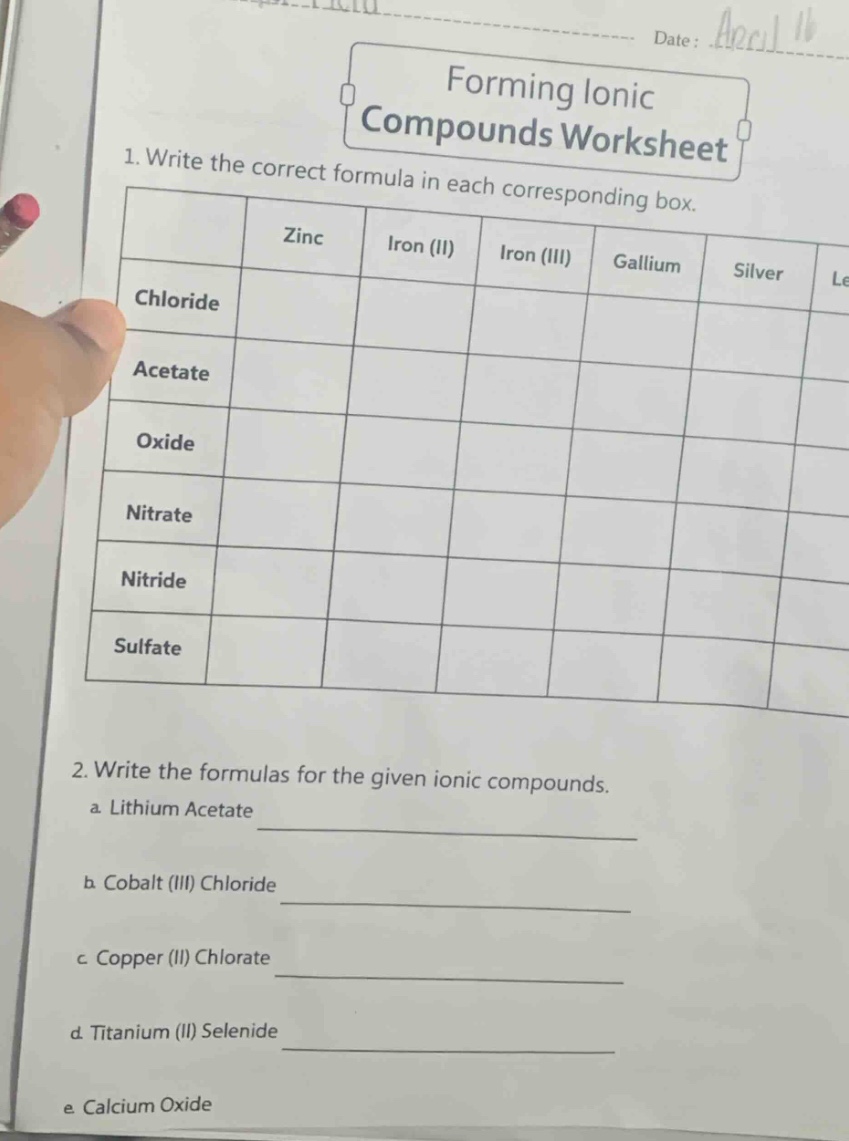
forming ionic compounds worksheet\n1. write the correct formula in each corresponding box.\n| | zinc | iron (ii) | iron (iii) | gallium | silver |\n|--|--|--|--|--|--| \n| chloride | | | | | |\n| acetate | | | | | |\n| oxide | | | | | |\n| nitrate | | | | | |\n| nitride | | | | | |\n| sulfate | | | | | |\n2. write the formulas for the given ionic compounds.\n a. lithium acetate \n b. cobalt (iii) chloride \n c. copper (ii) chlorate \n d. titanium (ii) selenide \n e. calcium oxide
Answer
Explanation:
Step1: Determine ion charges
Zinc has a charge of +2 ($Zn^{2 +}$), Iron (II) has a charge of +2 ($Fe^{2+}$), Iron (III) has a charge of +3 ($Fe^{3+}$), Gallium has a charge of +3 ($Ga^{3+}$), Silver has a charge of +1 ($Ag^{+}$). Chloride is $Cl^{-}$, Acetate is $C_{2}H_{3}O_{2}^{-}$, Oxide is $O^{2 -}$, Nitrate is $NO_{3}^{-}$, Nitride is $N^{3 -}$, Sulfate is $SO_{4}^{2 -}$. Lithium has a charge of +1 ($Li^{+}$), Cobalt (III) has a charge of +3 ($Co^{3+}$), Copper (II) has a charge of +2 ($Cu^{2+}$), Titanium (II) has a charge of +2 ($Ti^{2+}$), Calcium has a charge of +2 ($Ca^{2+}$).
Step2: Write formulas for table
Zinc
- Chloride: $ZnCl_{2}$ (2 $Cl^{-}$ balance $Zn^{2+}$)
- Acetate: $Zn(C_{2}H_{3}O_{2}){2}$ (2 $C{2}H_{3}O_{2}^{-}$ balance $Zn^{2+}$)
- Oxide: $ZnO$ (1 $O^{2 -}$ balances $Zn^{2+}$)
- Nitrate: $Zn(NO_{3}){2}$ (2 $NO{3}^{-}$ balance $Zn^{2+}$)
- Nitride: $Zn_{3}N_{2}$ (2 $N^{3 -}$ and 3 $Zn^{2+}$ for charge - balance)
- Sulfate: $ZnSO_{4}$ (1 $SO_{4}^{2 -}$ balances $Zn^{2+}$)
Iron (II)
- Chloride: $FeCl_{2}$ (2 $Cl^{-}$ balance $Fe^{2+}$)
- Acetate: $Fe(C_{2}H_{3}O_{2}){2}$ (2 $C{2}H_{3}O_{2}^{-}$ balance $Fe^{2+}$)
- Oxide: $FeO$ (1 $O^{2 -}$ balances $Fe^{2+}$)
- Nitrate: $Fe(NO_{3}){2}$ (2 $NO{3}^{-}$ balance $Fe^{2+}$)
- Nitride: $Fe_{3}N_{2}$ (2 $N^{3 -}$ and 3 $Fe^{2+}$ for charge - balance)
- Sulfate: $FeSO_{4}$ (1 $SO_{4}^{2 -}$ balances $Fe^{2+}$)
Iron (III)
- Chloride: $FeCl_{3}$ (3 $Cl^{-}$ balance $Fe^{3+}$)
- Acetate: $Fe(C_{2}H_{3}O_{2}){3}$ (3 $C{2}H_{3}O_{2}^{-}$ balance $Fe^{3+}$)
- Oxide: $Fe_{2}O_{3}$ (3 $O^{2 -}$ and 2 $Fe^{3+}$ for charge - balance)
- Nitrate: $Fe(NO_{3}){3}$ (3 $NO{3}^{-}$ balance $Fe^{3+}$)
- Nitride: $FeN$ (1 $N^{3 -}$ and 1 $Fe^{3+}$ for charge - balance)
- Sulfate: $Fe_{2}(SO_{4}){3}$ (3 $SO{4}^{2 -}$ and 2 $Fe^{3+}$ for charge - balance)
Gallium
- Chloride: $GaCl_{3}$ (3 $Cl^{-}$ balance $Ga^{3+}$)
- Acetate: $Ga(C_{2}H_{3}O_{2}){3}$ (3 $C{2}H_{3}O_{2}^{-}$ balance $Ga^{3+}$)
- Oxide: $Ga_{2}O_{3}$ (3 $O^{2 -}$ and 2 $Ga^{3+}$ for charge - balance)
- Nitrate: $Ga(NO_{3}){3}$ (3 $NO{3}^{-}$ balance $Ga^{3+}$)
- Nitride: $GaN$ (1 $N^{3 -}$ and 1 $Ga^{3+}$ for charge - balance)
- Sulfate: $Ga_{2}(SO_{4}){3}$ (3 $SO{4}^{2 -}$ and 2 $Ga^{3+}$ for charge - balance)
Silver
- Chloride: $AgCl$ (1 $Cl^{-}$ balances $Ag^{+}$)
- Acetate: $AgC_{2}H_{3}O_{2}$ (1 $C_{2}H_{3}O_{2}^{-}$ balances $Ag^{+}$)
- Oxide: $Ag_{2}O$ (1 $O^{2 -}$ and 2 $Ag^{+}$ for charge - balance)
- Nitrate: $AgNO_{3}$ (1 $NO_{3}^{-}$ balances $Ag^{+}$)
- Nitride: $Ag_{3}N$ (1 $N^{3 -}$ and 3 $Ag^{+}$ for charge - balance)
- Sulfate: $Ag_{2}SO_{4}$ (1 $SO_{4}^{2 -}$ and 2 $Ag^{+}$ for charge - balance)
Step3: Write formulas for part 2
a. Lithium Acetate
$LiC_{2}H_{3}O_{2}$ (1 $Li^{+}$ and 1 $C_{2}H_{3}O_{2}^{-}$)
b. Cobalt (III) Chloride
$CoCl_{3}$ (3 $Cl^{-}$ balance $Co^{3+}$)
c. Copper (II) Chlorate
$Cu(ClO_{3}){2}$ (2 $ClO{3}^{-}$ balance $Cu^{2+}$)
d. Titanium (II) Selenide
$TiSe$ (1 $Se^{2 -}$ balances $Ti^{2+}$)
e. Calcium Oxide
$CaO$ (1 $O^{2 -}$ balances $Ca^{2+}$)
Answer:
| Zinc | Iron (II) | Iron (III) | Gallium | Silver | |
|---|---|---|---|---|---|
| Chloride | $ZnCl_{2}$ | $FeCl_{2}$ | $FeCl_{3}$ | $GaCl_{3}$ | $AgCl$ |
| Acetate | $Zn(C_{2}H_{3}O_{2})_{2}$ | $Fe(C_{2}H_{3}O_{2})_{2}$ | $Fe(C_{2}H_{3}O_{2})_{3}$ | $Ga(C_{2}H_{3}O_{2})_{3}$ | $AgC_{2}H_{3}O_{2}$ |
| Oxide | $ZnO$ | $FeO$ | $Fe_{2}O_{3}$ | $Ga_{2}O_{3}$ | $Ag_{2}O$ |
| Nitrate | $Zn(NO_{3})_{2}$ | $Fe(NO_{3})_{2}$ | $Fe(NO_{3})_{3}$ | $Ga(NO_{3})_{3}$ | $AgNO_{3}$ |
| Nitride | $Zn_{3}N_{2}$ | $Fe_{3}N_{2}$ | $FeN$ | $GaN$ | $Ag_{3}N$ |
| Sulfate | $ZnSO_{4}$ | $FeSO_{4}$ | $Fe_{2}(SO_{4})_{3}$ | $Ga_{2}(SO_{4})_{3}$ | $Ag_{2}SO_{4}$ |
a. $LiC_{2}H_{3}O_{2}$ b. $CoCl_{3}$ c. $Cu(ClO_{3})_{2}$ d. $TiSe$ e. $CaO$