5. the function c(x) = 68(1.05)^x models the cost in dollars, c, of 1 ounce of a certain chemical used in a…
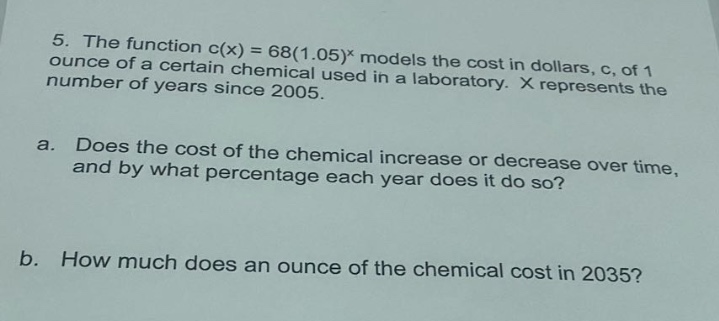
5. the function c(x) = 68(1.05)^x models the cost in dollars, c, of 1 ounce of a certain chemical used in a laboratory. x represents the number of years since 2005.\na. does the cost of the chemical increase or decrease over time, and by what percentage each year does it do so?\nb. how much does an ounce of the chemical cost in 2035?
Answer
Explanation:
Step1: Analyze the growth - factor
The general form of an exponential function is $y = a(b)^x$, where $a$ is the initial value and $b$ is the growth/decay factor. In the function $c(x)=68(1.05)^x$, since $b = 1.05>1$, the cost increases. The percentage increase is given by $(b - 1)\times100%$. So, $(1.05 - 1)\times100%=5%$.
Step2: Calculate the value of $x$ for 2035
The year is 2035 and the base - year is 2005. So, $x=2035 - 2005=30$.
Step3: Find the cost in 2035
Substitute $x = 30$ into the function $c(x)=68(1.05)^x$. So, $c(30)=68\times(1.05)^{30}$. Calculate $(1.05)^{30}\approx4.321942$. Then $c(30)=68\times4.321942\approx293.89$.
Answer:
a. The cost of the chemical increases by 5% each year. b. An ounce of the chemical costs approximately $$293.89$ in 2035.